
Crusher Impact Plates: Breaker & Apron Liners
Crusher Impact Plates: Breaker Plates, Apron Liners & Material Selection Guide
A single set of worn crusher impact plates can quietly drain a limestone quarry of more than $800 per hour in lost throughput, rework and unplanned stoppages. Most plant managers blame the blow bars first. The stationary liner bolted behind the rotor is the component that actually shapes your product and absorbs the heaviest abuse. When that liner is the wrong material for the feed, you pay twice. You pay once in premature wear and again in poor gradation that fails the spec sheet.
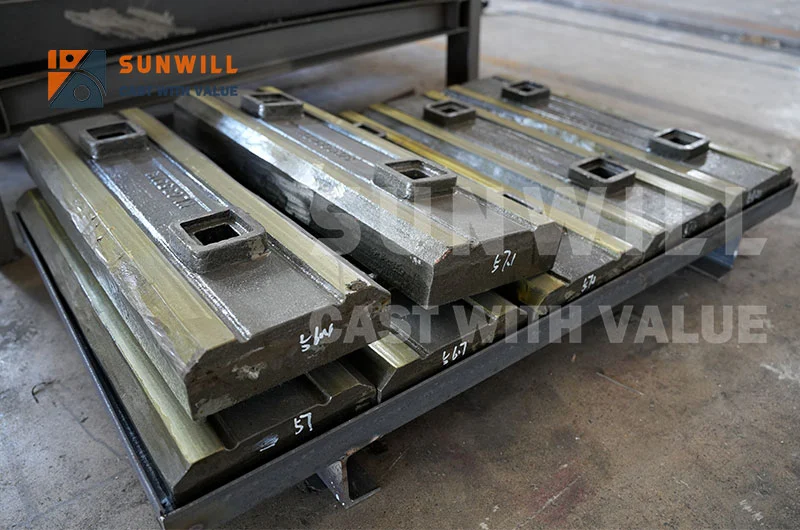
Crusher impact plates, also called breaker plates or apron liners, are the fixed anvils inside a horizontal shaft impactor (HSI) that the spinning blow bars throw rock against. They decide how many times a stone gets struck, at what angle, and what size it leaves the crushing chamber. This guide explains how impact plates work, the four material families Sunwill casts for them (chrome casting, chrome with ceramic inlay, martensitic steel casting, and martensitic steel casting with ceramic inlay), how to set the gap and nip angle, and how to match plates to your blow bars and feed material.
★ Crusher impact plates are the stationary liners your blow bars throw rock against, and they control product shape and gradation more than most operators realize.
What Are Impact Plates (Breaker Plates / Apron Liners)?
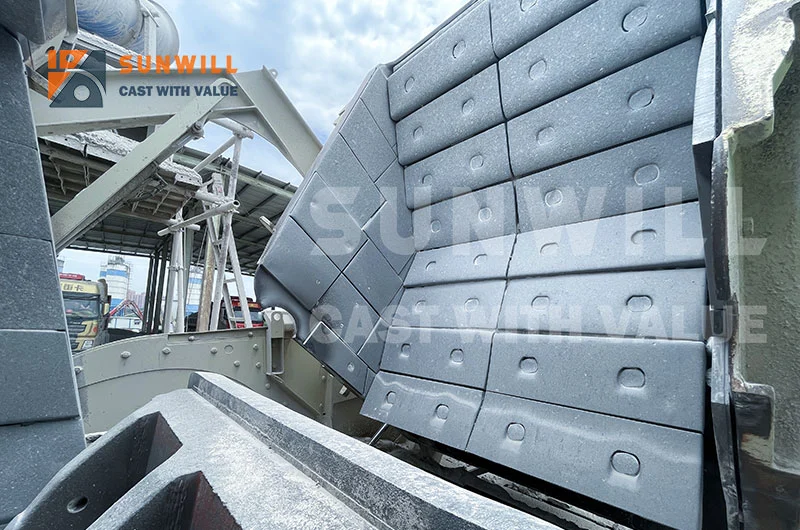
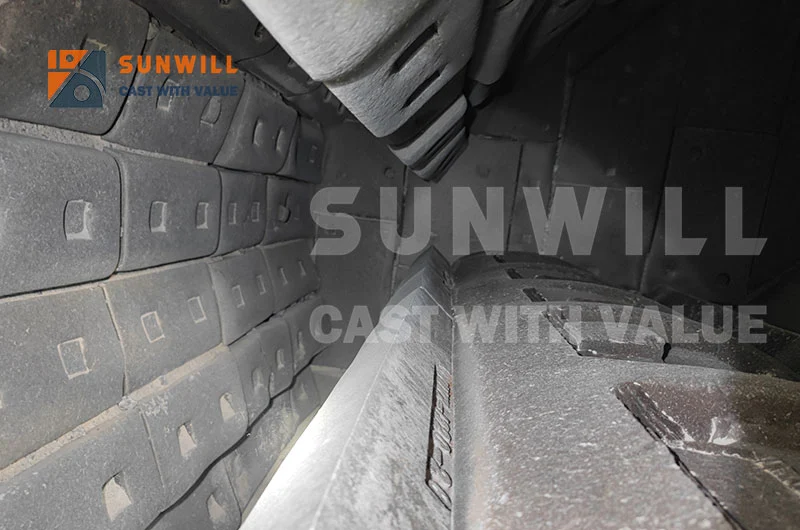
In a horizontal shaft impact crusher, the rotor spins blow bars at speed. Material is fed into the chamber and flung against the impact plates. The plates are stationary wear faces mounted on adjustable aprons. Each impact event fractures the rock, and the geometry of the plate decides whether the stone is hit again, deflected, or discharged. The plates are the anvil. The blow bars are the hammer.
Three names describe the same family of parts depending on region and OEM. “Breaker plate” is common on Hazemag and older European machines. “Apron liner” is the term Metso and many North American operators use for the wear face on the apron. “Impact curtain” sometimes refers to the whole apron assembly, while “crusher impact curtains” can mean the liner strips inside it. Across all of these labels, the function is identical: provide a wear-resistant surface that rock is thrown against.
The key difference from blow bars is motion. Blow bars rotate with the rotor and take the primary impact. Impact plates stay fixed and act as the anvil. Because they do not move, their wear is more uniform and more predictable, which makes them easier to plan for. That predictability is exactly why material choice matters so much. A plate that wears evenly lets you forecast changeouts. A plate in the wrong material fails early and unpredictably.
An impact plate is not one solid block in every design. Many aprons carry segmented liner strips bolted to a curved backing beam. Segmentation lets you replace only the worn center strip instead of the whole curtain. It also lets you mix materials across a single apron, putting a tougher grade at the leading edge and a harder grade in the center wear zone.
Need help choosing a material for your impact plates? Open our blow bar material selection guide for a side by side look at chrome casting, martensitic steel casting, and ceramic inlay options.
Field note: A 600 tph limestone plant in southern China ran OEM martensitic plates that lasted about 9 weeks before edge grooving pushed product above the 30 mm top size. After switching to a Sunwill chrome casting plate set with ceramic inlay, the same duty ran 21 weeks before the wear limit, and the fraction above 30 mm dropped from 12 percent to 4 percent. [VERIFY: plant identity, run hours, and gradation figures are from a field note and should be confirmed with the client before publication.]
Primary, Secondary and Tertiary Impact Zones
Most HSIs run two or three impact aprons, each forming a crushing zone. The primary apron sits closest to the feed and takes the first, largest hit. The secondary apron refines the partially crushed material. A tertiary apron, when present, polishes the product and tightens the gradation. Each zone is a separate opportunity to tune the output.
Each zone wears at a different rate. The primary plate sees the biggest rock and the highest energy impact, so it often needs the toughest material. The secondary and tertiary plates handle smaller, already-fractured stone, so abrasion and rubbing dominate over impact. Lining each zone with the right material is the difference between a balanced wear schedule and one plate failing weeks before the others.
The spacing between aprons also sets the cascade. A tighter primary gap forces more recirculation and more impacts, which improves shape but raises wear. A more open setting increases throughput but can leave slabby product. Good chamber design is a trade off, and the impact plates are where you make it. A well set chamber runs all zones to a similar end of life, so one shutdown replaces everything.
Crushing stages inside one machine also change the feed to later zones. Rock that enters at 400 mm might leave the primary zone at 120 mm, the secondary at 50 mm, and the tertiary at 25 mm. The liner that is perfect for 400 mm boulders is wrong for 25 mm chips. Designers therefore often specify a different plate material and profile for each apron rather than one size fits all.
Impact Plate Materials: Chrome Casting, Martensitic Steel, and Ceramic Inlay
Sunwill casts crusher impact plates in four wear solutions built from two base alloys. The two base alloys are high-chrome white iron (chrome casting) and martensitic steel casting. Each base alloy is offered plain or with a ceramic inlay, which gives the four options below. We do not produce high-manganese (Hadfield) steel plates, so the table shows the actual program we offer.
| Material | Best zone | Strength | Watch out for |
|---|---|---|---|
| Chrome casting plates | Secondary, tertiary | Maximum abrasion resistance (high-chrome) | Brittle under heavy impact |
| Chrome casting plates with ceramic inlay | Any abrasive duty | Longest wear life on abrasive feeds | Higher upfront cost |
| Martensitic steel casting plates | Primary apron | High toughness, resists big impacts | Lower hardness than chrome |
| Martensitic steel casting plates with ceramic inlay | Primary plus abrasive, mixed | Toughness with added wear life | Higher upfront cost |
Chrome Casting Plates (High-Chrome White Iron)
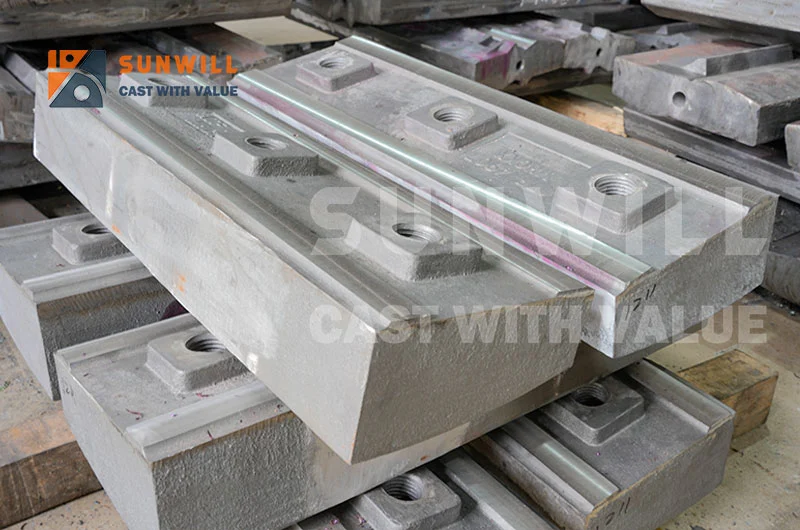
Chrome casting plates use high-chrome white iron (per ASTM A532 classes), the wear king for sliding abrasion. They are very hard and resist the grinding action of fine, siliceous feeds. The trade off is brittleness, so chrome casting plates belong in the secondary and tertiary zones where impact energy is lower, not at the primary apron where a big boulder can spall them. Chromium content typically runs 15 to 26 percent depending on the grade [VERIFY].
For a limestone quarry with low silica, plain chrome casting in the later zones can deliver excellent cost per ton. For a granite or basalt duty with high free silica, chrome casting at the primary apron is a mistake waiting to happen. Zone placement is everything with this alloy.
Chrome Casting Plates with Ceramic Inlay
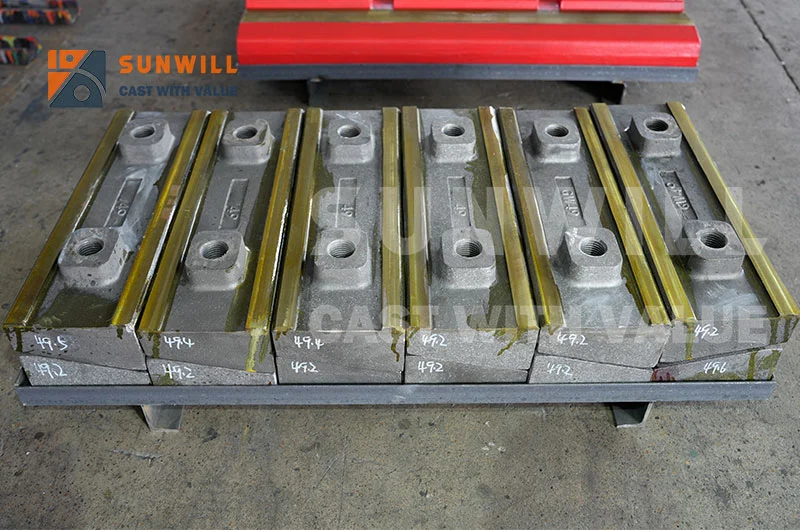
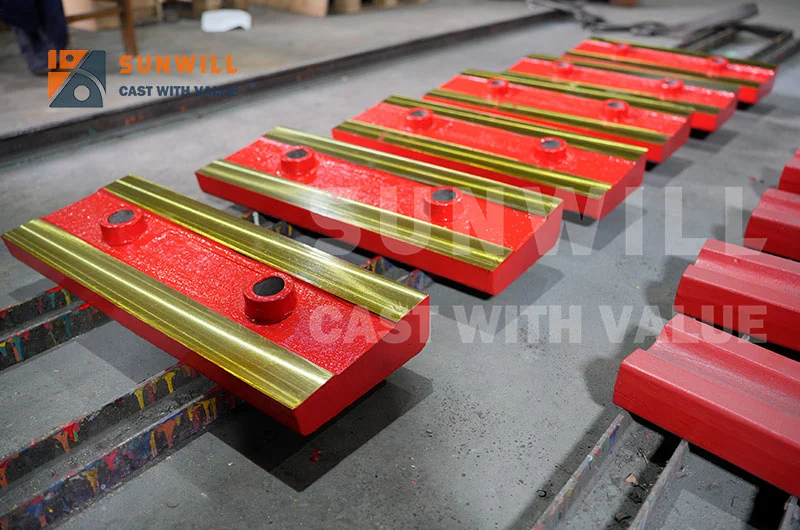
Adding a ceramic inlay to chrome casting plates puts hard ceramic blocks right at the wear face while keeping the high-chrome matrix around them. The result is the longest service life of the four options on abrasive feeds such as granite or high-silica limestone, because the ceramic resists grinding far longer than the iron alone. The trade off is a higher upfront cost, which pays back when downtime cost outweighs material cost. This is the option we recommend most often for plants that measure success in cost per ton.
Martensitic Steel Casting Plates
Martensitic steel casting plates give the best toughness of the four options. They resist the heavy, single hits at the primary apron without cracking. For feeds with tramp risk (rebar, boulders, uncrushable fragments), martensitic plates are the safe default. Hardness sits in a moderate range [VERIFY: typical 50 to 60 HRC], which is lower than chrome casting but high enough for most quarry rock.
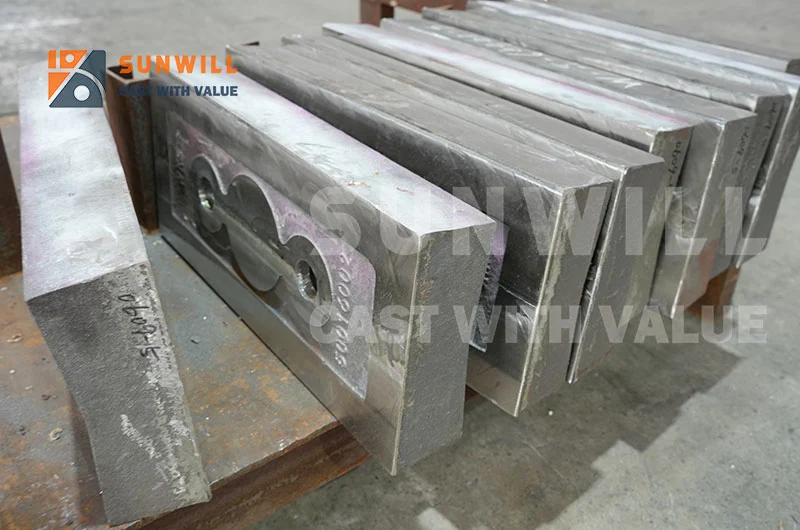
Martensitic plates are also the easiest to weld and build up. If a plant runs hardfacing on site, a martensitic substrate takes rebuild alloy well, which can extend service between full replacements. That field-repairability is a real advantage on remote sites where spare delivery is slow.
Martensitic Steel Casting Plates with Ceramic Inlay
A ceramic inlay inside a martensitic steel casting plate joins the toughness of martensitic with the wear resistance of ceramic. This is the right call for the primary apron when the feed is both high impact and abrasive, the case where plain chrome casting would spall and plain martensitic would wear too fast. The inlay carries the rubbing wear while the martensitic body absorbs the shock. As with the chrome version, the trade off is a higher upfront cost.
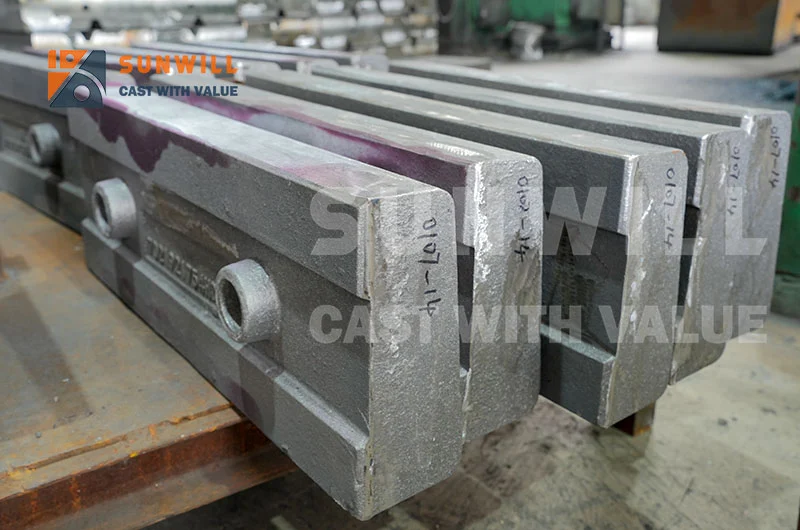
Objective note on high-manganese: Some competitors and OEMs list high-manganese (Hadfield) steel for impact plates. That material work-hardens under heavy impact and is a traditional choice in certain crusher zones. Sunwill’s program meets the same wear zones with chrome casting and martensitic steel casting, each plain or with a ceramic inlay. We do not cast high-manganese (Hadfield) steel, so buyers comparing suppliers should note the difference in material strategy rather than assuming all foundries offer the same alloys.
★ Sunwill offers four impact plate materials: chrome casting plates, chrome casting with ceramic inlay, martensitic steel casting plates, and martensitic steel casting with ceramic inlay. We do not produce high-manganese (Hadfield) steel plates.
Adjustable Apron Liners and Nip Angle Control
The aprons pivot on a shaft and are pushed toward or away from the rotor by hydraulic rams or mechanical wedges. Moving an apron changes the gap between the blow bar tip and the plate face. That gap (the closed side setting, or CSS, at the impact point) is the main product-size control you have. Close it and product gets finer. Open it and throughput rises.
Nip angle is the angle at which rock meets the plate. Too steep and the stone is thrown back into the rotor instead of being retained for another hit. Too shallow and material slips past with little crushing. Adjusting the apron radius and the liner profile lets you tune the nip angle for your feed. A steeper primary liner bites large feed; a flatter liner lets fines escape to the next zone.
Modern machines allow each apron to be set independently. A common setup opens the primary gap for throughput and closes the tertiary gap for shape. Some plants automate the setting with hydraulic sensors that log the gap and warn when wear moves it out of range. Whether manual or automatic, the principle is the same: the plate position is your shape and size dial.
Tramp relief is built into the adjustment. When an uncrushable object jams the chamber, the apron yields and then resets, protecting the plates and rotor. A plate in the right tough material survives these events. A brittle plate can spall on the first big tramp, which is why primary-zone material choice is a safety and uptime decision, not just a wear decision.
How Impact Plates Affect Product Shape and Gradation
Product shape in an HSI is governed by how many impacts a stone receives and at what angle. The impact plates set both. A plate with a stepped or ribbed profile promotes rock-on-rock crushing, which yields the cubical, low-flakiness product that asphalt and concrete specs demand. A smooth plate produces more rock-on-plate contact, which is cheaper to run but can leave slabby pieces.
Gap setting changes the fines balance. Closing the tertiary gap forces extra impacts and improves cube shape, but it also raises the minus 5 mm fraction. Opening it trims fines but risks a coarse, poorly shaped top size. The art is matching the plate set to the target sieve curve, not to a single number on the dial. Experienced operators read the stockpile, not just the gauge.
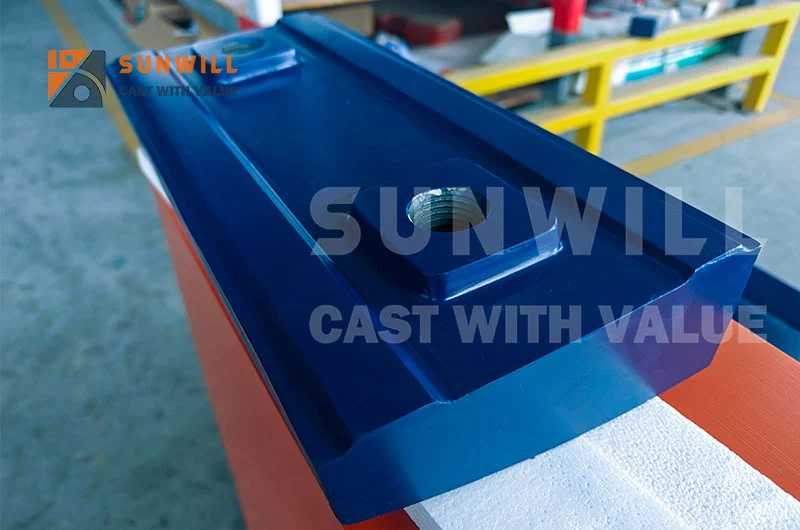
Gradation also depends on even wear. A plate that wears unevenly (heavy at the edges, thin in the middle) throws the curtain off level and skews the product. That is why inspection and timely rotation matter as much as material choice. A perfectly specified plate in a poorly maintained chamber will still make bad product.
The liner profile interacts with the blow bar style. A flat plate behind a flat bar gives clean, hard impacts suited to coarse fragmentation. A stepped plate behind a stepped bar multiplies the rock-on-rock events that shape cubical aggregate. When we spec a plate set, we ask for the blow bar profile first, because the two parts are a pair, not separate purchases.
Field note: A granite contractor in Southeast Asia complained that his HSI product failed the flakiness index for a road-base spec. The culprit was a smooth high-chrome primary plate running against martensitic blow bars, with the primary gap set too open. After we supplied a stepped ceramic-inlay primary plate and closed the gap by 8 mm, the flakiness index moved from 28 to 16 percent and the mix passed. [VERIFY: site name, gap change, and index values are from a field note pending client confirmation.]
Matching Impact Plates to Blow Bars and Feed Material
The plate and the blow bar work as a pair. Match the pair to the feed, not to a catalog default. For soft, low-silica limestone, martensitic plates paired with martensitic blow bars give long, low-cost life. For abrasive granite or high-silica ore, ceramic-inlay plates behind ceramic-insert blow bars win on total cost per ton, even at higher upfront price.
Our high-chrome vs martensitic steel comparison breaks down where each matrix earns its place. For a typical limestone duty, the limestone quarry blow bars guide shows the paired setup we recommend.
Feed factors to weigh:
- Abrasiveness (silica content): high silica favors ceramic inlay or chrome casting.
- Feed size and top size: large feed at the primary apron favors tough martensitic.
- Tramp risk: rebar or boulders favor martensitic steel casting, plain or with ceramic inlay, for crack resistance.
- Target shape: cubical product favors stepped profiles and tighter tertiary gaps.
- Throughput target: high tph favors open primary gaps and abrasion-resistant later zones.
A simple way to think about it: put toughness where the energy is highest, and put hardness where the rubbing is worst. The primary apron is an energy zone, so martensitic steel casting, plain or with ceramic inlay. The tertiary apron is a rubbing zone, so chrome casting or chrome with ceramic inlay. When the duty is mixed, a martensitic plate with ceramic inlay brings toughness and wear resistance in one part.
Planning a plate and blow bar change together? Review our blow bar material selection guide and send us your chamber drawing so we can spec the matching plate set in one go.
OEM Compatibility (Metso NP, Sandvik QI, Hazemag, Kleemann)
Sunwill supplies aftermarket impact plates that fit the common HSI platforms. For Metso NP series machines, the apron and breaker plate geometry is well documented and our foundry works to the original chamber envelope [reference: Metso chamber data]. Sandvik QI series, Hazemag primary impactors and Kleemann MOBI units each have their own apron radii and liner bolt patterns, and we produce to drawing or to a measured worn sample.
Fit is not just the bolt hole. The liner must match the apron curvature and the local gap so the CSS you set is the CSS you get. We confirm the apron radius, liner thickness and bolt centers against your model before casting. A plate that sits proud of the apron backing changes the gap by millimeters and can shift your whole product curve.
For plants running mixed fleets, we keep drawings on file for the major platforms and can cross reference a worn plate to the correct aftermarket part. This avoids the common mistake of ordering a plate that fits the bolts but not the chamber. For a broader view of our crusher program, see our mining wear parts overview.
When you request a quote, send the machine tag, the apron position (primary, secondary or tertiary), and a photo of the worn liner showing the bolt pattern. That single email lets our engineers confirm compatibility and recommend the right material without a site visit. For multi-machine sites, a wear profile per machine lets us balance inventory so every changeout has a spare ready.
Inspection, Wear Signs and Replacement
Inspect impact plates on the same schedule as blow bars, typically at every rotor service. Look for these wear signs:
- Edge grooving where the curtain meets the frame, which skews the gap.
- Localized deep scoring from hard inclusions or tramp steel.
- Thinning at the impact center line, the zone that takes the most energy.
- Cracked or elongated bolt holes, a sign the plate is shifting under load.
- Spall marks or corner fractures on high-chrome plates, a signal of impact overload.
Measure remaining liner thickness at the worn center and compare it to the wear limit in your manual [VERIFY: model specific minimum thickness]. Many plates are reversible or can be rotated top to bottom to use both faces, which can add weeks of life at no extra cost. Mark the date and thickness at each inspection so the wear rate is a known number, not a guess.
Replace before the liner reaches the backing or the apron structure. A plate worn through transfers impact loads straight to the apron, and that repair is far more expensive than a planned liner change. Keep a matched spare set on site so a weekend change never becomes a week of downtime. The cost of one spare plate is small against the cost of a stopped crusher.
A good inspection routine also checks the apron backing. If the plate is loose, the gap wanders even when the liner itself looks fine. Torque the hold-down bolts to spec at every service and watch for the telltale rattle that means a plate has started to walk. Catching a loose plate early prevents the edge damage that ruins an otherwise healthy liner.
Field note: An aggregate plant delayed replacing a primary plate because the center was still thick, missing the edge grooving that had pushed the real gap open by 15 mm. The result was oversize product and a rotor imbalance that cracked a blow bar seat. A planned swap would have cost one shift; the unplanned repair cost six. [VERIFY: downtime and damage figures are from a field note and need client confirmation.]
★ Inspect impact plates at every rotor service and replace on remaining thickness, not on appearance, because edge grooving can open the gap long before the center looks worn.
Conclusion
Crusher impact plates are the stationary anvils that shape your product and set your wear cost. Pick the material by zone and feed: martensitic steel casting where impact rules, chrome casting where abrasion rules, and add the ceramic inlay (to either base alloy) where both are extreme or the duty is mixed. Set the gaps and nip angles to your sieve curve, match the plates to your blow bars, and inspect on a fixed schedule.
Sunwill casts these plates in chrome casting and martensitic steel casting, each available plain or with a ceramic inlay. We do not produce high-manganese (Hadfield) steel, so our recommendations are built around the four families above. Send us your impactor model and a worn sample, and our engineers will recommend the plate set that lowers your cost per ton.
Ready to spec your next impact plate set? Browse our full mining wear parts range or send your chamber drawing to our foundry team for a quote.