
Blow Bar Material Specs: Hardness & Composition Guide
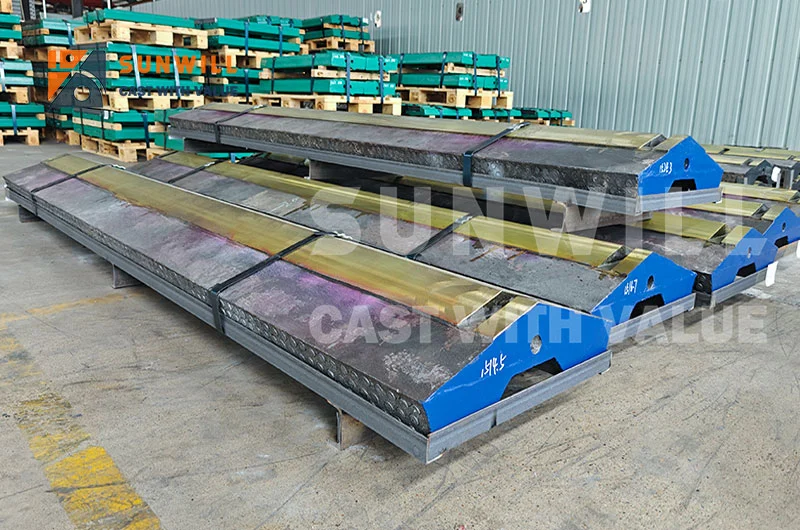
Blow Bar Material Technical Specifications: Composition, Hardness & Performance Trade-offs
David Chen stared at two supplier quotes on his screen and felt the familiar headache return. Both described blow bar material specifications for his limestone quarry, yet the numbers spoke two different languages. Supplier A promised a blow bar rated at 62 HRC. Supplier B quoted 350 HB. Same crusher, same feed, wildly different numbers. Which bar was actually harder, and which would survive longer in his plant? David is not alone. Most crushing engineers have faced this wall of incompatible hardness scales, and the confusion quietly drives expensive purchasing mistakes. This article is the unified reference you have been missing. We lay out the six major blow bar materials with their exact composition and hardness values, explain why HRC, HB and HV are not interchangeable, and show you how to read the wear versus impact trade-off that decides real world performance.
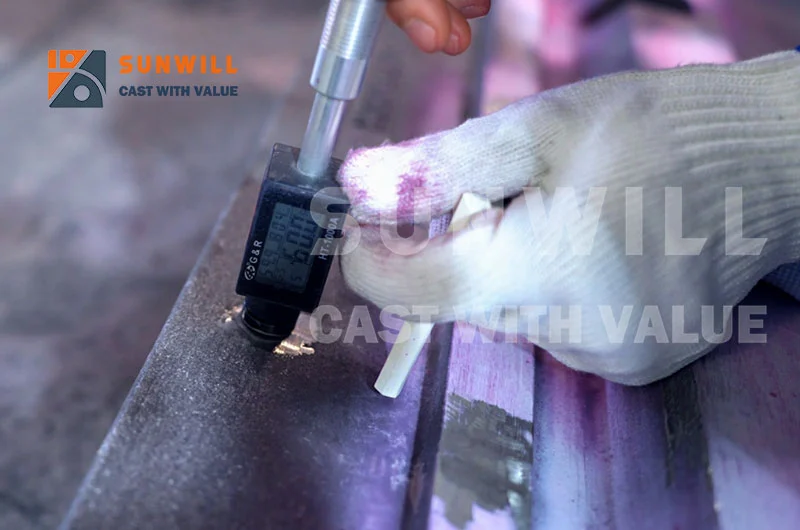
You run an impact crusher and need a blow bar that does not shatter on the first boulder yet does not erode by lunchtime. We agree that sorting through Cr percentages, carbide types and hardness scales feels like decoding a foreign standard. Here is our promise: by the end of this page you will hold an accurate spec sheet to send any supplier plus a clear framework for matching material to duty. We preview the six material families, the hardness scale logic, a visual wear impact map, an application matrix, a cost per ton model and the ceramic and TiC technologies reshaping the category.
Key Takeaways
– High chrome irons deliver the highest matrix hardness at greater than 60 HRC but rank lowest on impact toughness, so they suit low to medium shock duty only.
– Ceramic reinforcement (ZTA honeycomb or TiC rods) lifts wear life roughly 2 to 4 times versus the base alloy without lowering the matrix impact resistance.
– No single material wins every job; the right choice is the one that balances abrasion resistance and impact toughness for your specific feed.
– Manganese steel starts soft at greater than 250 HB but work hardens toward 450 to 500 HB under impact, which is why it fails fast when the load never shocks it.
– Ceramic and TiC composite bars cost more up front yet lower cost per ton through fewer change outs and less downtime, the core idea behind SUNWILL’s CAST WITH VALUE promise.
Understanding Hardness Scales: HRC vs HB vs HV
Before comparing any blow bar material composition HRC value against a Brinell or Vickers number, you need to know why the industry uses three different rulers. None of them is “wrong”. They simply measure different things, and mixing them without context is how good engineers buy the wrong bar.
Why different materials use different scales
The Rockwell C (HRC) scale drives a diamond cone into the surface under a major load and reads the penetration depth. It works best on hard, shallow materials, which is exactly why high chrome and martensitic bars are quoted in HRC. The Brinell (HB) scale presses a hardened steel ball into the part and measures the width of the impression. It averages over a larger area, so it suits ductile, work hardening metals like manganese steel where a localized Rockwell reading would mislead. The Vickers (HV) scale uses a diamond pyramid and works across the full hardness range, which makes it the only practical tool for ceramic phases that sit far above the HRC ceiling.
A ceramic insert at 1400 HV simply cannot be expressed on the Rockwell C scale because the cone would shatter before registering a number. That is a measurement boundary, not a material weakness.
A rough conversion you can use in the field
Treat the table below as a directional guide only. Hardness conversion is not a precise math function because it depends on the material’s modulus, carbide volume and heat treatment. Never quote these as exact equivalents on a purchase order.
| Observable reading | Rough HRC band | Rough HB band | Where you see it |
|---|---|---|---|
| Ceramic phase | Above scale | Above scale | 1400 to 1700 HV (ZTA) |
| High chrome matrix | 60+ | 650 to 700+ | High chrome, high chrome ceramic |
| Martensitic matrix | 53 to 58 | 530 to 620 | Martensitic, martensitic ceramic |
| Manganese as cast | 25 to 30 (approx) | 250 (as cast) | Manganese, manganese TiC |
| Manganese work hardened | 45 to 50 (approx) | 450 to 500 | Surface after impact |
Notice the trap. Manganese at 250 HB looks dramatically “softer” than high chrome at 60 HRC, yet in service the manganese surface can rival the chrome in hard contact zones. The static number is not the whole story.
The beginner mistake: “higher HRC is always better”
The single most expensive assumption in crusher wear parts is that the biggest hardness number wins. It does not. Hardness and toughness pull in opposite directions. Push matrix hardness too high and you get a bar that resists abrasion beautifully but snaps on the first oversize rock or piece of tramp steel. High chrome at 62 HRC is brilliant in steady, low shock grinding and fragile under a 500 mm boulder. Manganese at 250 HB shrugs off that same boulder because it deforms instead of cracking. The goal is never maximum hardness. The goal is the right balance for the duty, which is the theme of this entire article.
A quick note for specifiers: SUNWILL can specify and source Ni-Hard grades to ASTM A532 (a nickel chromium white iron family) for projects that require them, but these are not held as standard stock. Tungsten carbide (WC) overlay and hardfaced bars are mentioned here only as a comparison baseline, not as a SUNWILL production line.
The Six Major Blow Bar Material Categories
Every blow bar on the market traces back to one of six material architectures. Two are base alloys, two add ceramic honeycomb reinforcement, and two build on manganese steel with either plain chemistry or TiC carbide rods. The table below is the spine of this article. Save it, print it, and send it to suppliers so everyone quotes on the same vocabulary.
| Blow bar Material | Main Composition | Hardness |
|---|---|---|
| High Chrome | Cr >20%, C >2.8%, Mo/Ni alloy | Matrix >60 HRC |
| High Chrome + Ceramic | Chrome base + ZTA ceramic honeycomb | Matrix >60 HRC / Ceramic >1400 HV |
| Martensitic | Cr >4%, C >3.5%, Mo/Ni alloy | Matrix >53 HRC |
| Martensitic + Ceramic | Martensitic base + ZTA ceramic honeycomb | Matrix >53 HRC / Ceramic >1400 HV |
| Manganese | Mn >13%, C >1% | >250 HB |
| Manganese + TiC | Manganese base + TiC carbide rods | Matrix >250 HB / TiC >63 HRC |
1. High Chrome (High Chromium White Iron)
High chrome blow bars are cast from a white iron with Cr above 20 percent, C above 2.8 percent, and molybdenum and nickel as the key alloying elements. The high chromium content drives the formation of chromium rich M7C3 carbides inside the matrix. Those carbides are themselves extremely hard, often testing 1200 to 1500 HV, and they form a continuous skeleton that carries the abrasion load.
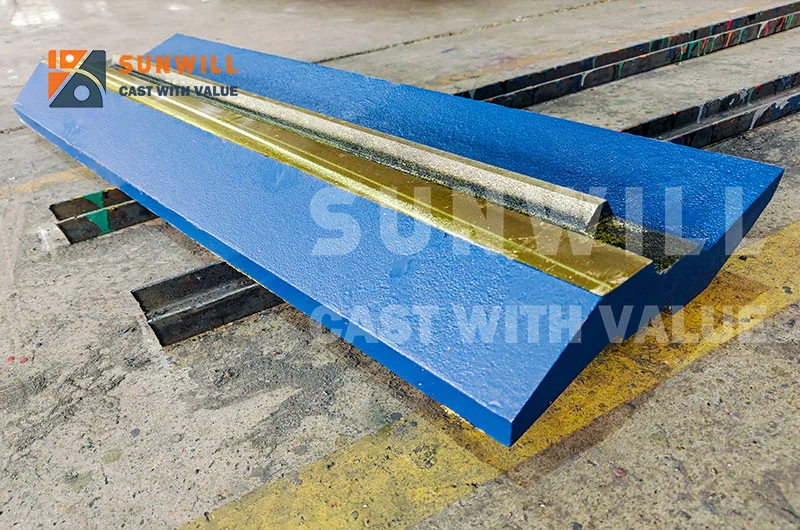
The measured matrix hardness sits at greater than 60 HRC, which places high chrome at the top of the wear resistance ladder. A typical 20 to 26 percent chrome grade reaches 58 to 64 HRC with impact toughness around 10 J/cm2, a low number that tells you everything about its weakness.
The microstructure is the story. A network of hard M7C3 carbides sits in a martensitic or austenitic matrix. The carbide skeleton fights wear. The matrix holds it together and absorbs what shock it can. The advantage is clear: in steady, low to medium impact duty, high chrome outwears almost everything else per dollar of purchase price.
The disadvantage is brittleness. Low impact toughness means a single oversize feed lump, a piece of tramp steel, or a frozen bearing can crack the bar. High chrome is a fine crushing and medium duty material, not a primary crusher boulder tamer.
Mini story: the granite mistake. Mike Olsen ran a granite aggregate plant in the Pacific Northwest and, chasing the highest hardness number on paper, specified high chrome bars for a primary horizontal shaft impactor. The feed included 400 to 600 mm boulders from the face. Within nine days he lost three bars to transverse cracking. The supplier had quoted 62 HRC, but the impact energy exceeded what that matrix could absorb. Mike’s failure is documented in our blow bar failure causes guide, and it is the textbook case of hardness chosen without the impact side of the equation. Switching to a martensitic grade stopped the breakage while a ceramic composite was trialed for wear life.
Typical applications: limestone fine and medium crushing, cement clinker, coal, and any low shock abrasive duty where feed is screened and tramp free.
2. High Chrome + Ceramic Composite
Take the high chrome bar above and embed a ZTA (zirconia toughened alumina) ceramic honeycomb into the wear face. The matrix still reads greater than 60 HRC, and now the ceramic phase tests greater than 1400 HV. Premium ZTA grades in the field often measure 1500 to 1700 HV, consistent with this threshold.
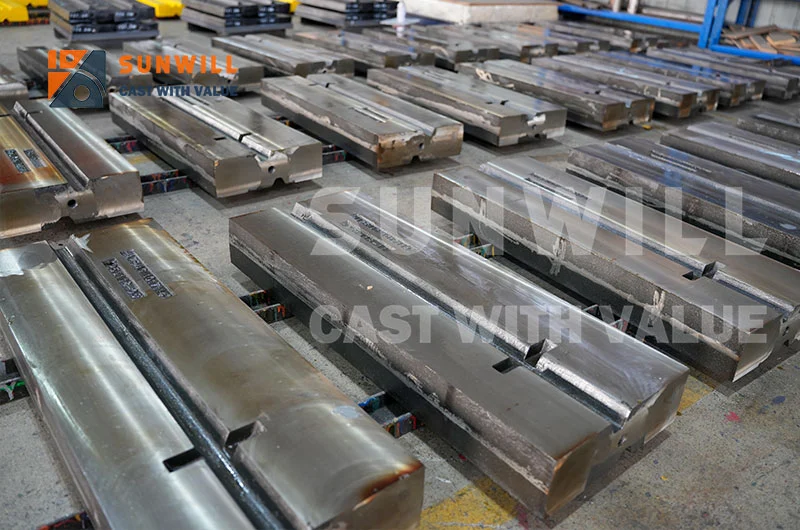
The working principle matters. The ceramic honeycomb acts as the ultra hard wear surface that carries abrasive contact, while the ductile high chrome matrix underneath absorbs impact and holds the ceramic in place. This is the first of our key insights: the ceramic reinforcement does not reduce the matrix impact resistance, it raises the wear ceiling while leaving toughness essentially unchanged. The bar is not more brittle because of the ceramic. It is simply harder where it matters most.
Field data shows ceramic composite blow bars extending service life roughly 2 to 4 times versus the equivalent plain high chrome bar, with some asphalt recycling trials reporting more than 4 times life and a wear rate drop near 78 percent. The economics flip the purchase price objection: you pay more per bar and change it a fraction as often.
Typical applications: highly abrasive materials such as river gravel, high silica rock, granite and quartzite secondary crushing where plain high chrome erodes too fast. For hard rock programs see our hard rock quarry blow bar resource.
3. Martensitic Alloy Steel
Martensitic bars use a leaner alloy than high chrome: Cr above 4 percent, C above 3.5 percent, again with molybdenum and nickel. After quenching and tempering the structure becomes martensite, a hard yet tougher phase than the carbide skeleton of white iron. Matrix hardness lands at greater than 53 HRC.
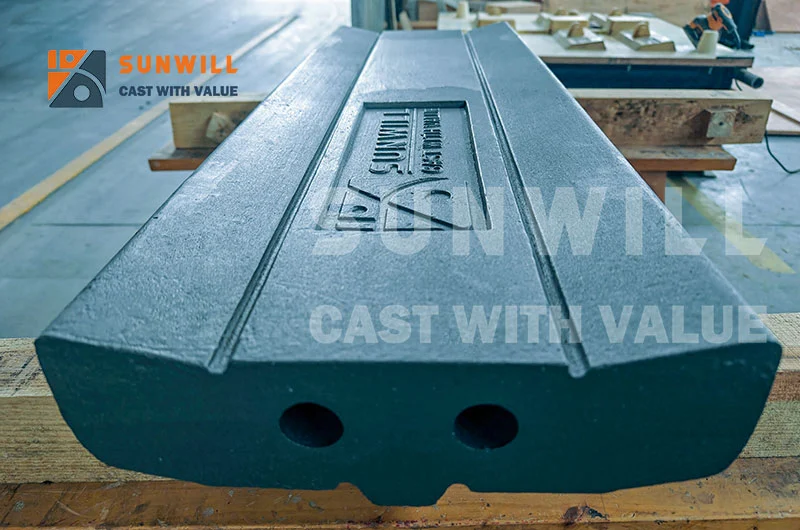
Martensite sits in the middle of the map. It is not as abrasion resistant as high chrome, and it is not as impact tough as manganese, but it is the most balanced single alloy available. Where the duty mixes moderate abrasion with moderate shock, martensitic steel is the safe default that avoids the brittleness of chrome and the soft start of manganese.
This balance is why martensitic bars are common in concrete recycling and granite medium crushing, where feed is variable, occasionally includes tramp, and pure high chrome would risk fracture. If you want the gating logic that decides when martensitic beats chrome or manganese, our blow bar selection by feed size guide walks through the decision tree.
4. Martensitic + Ceramic Composite
Replace the plain martensitic matrix with a martensitic base plus ZTA ceramic honeycomb and you get the same dual phase logic as the high chrome ceramic version. Matrix hardness stays at greater than 53 HRC, ceramic at greater than 1400 HV.
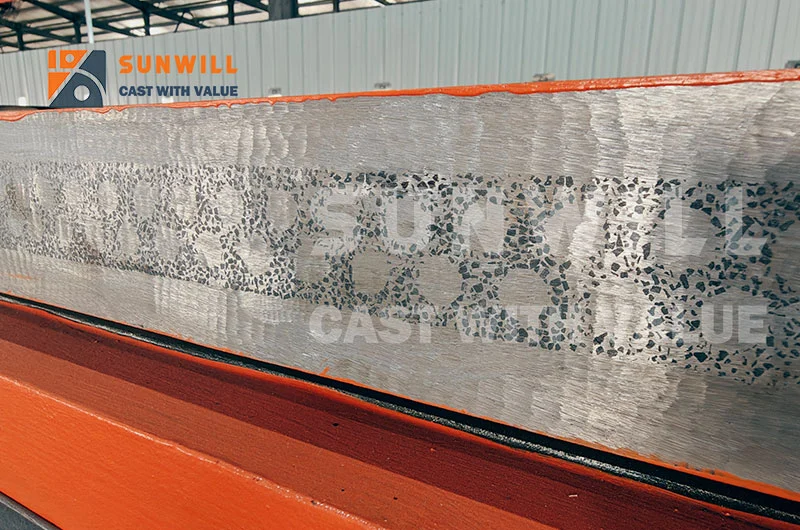
The combination is powerful because the tougher martensitic base tolerates more impact than high chrome, while the ceramic face delivers chrome class wear resistance. You effectively get a bar that handles both shocks and abrasion in a way neither plain alloy achieves alone. This is the practical answer for duties that punish single material solutions.
Typical applications: concrete recycling with embedded steel, limestone quarries that need both impact tolerance and long wear life, and mixed demolition feeds. When wear patterns look inconsistent, our impact crusher wear troubleshooting guide helps separate material mismatch from setting and feed distribution problems.
5. Manganese Steel (Austenitic)
Manganese blow bars are the old workhorse of the industry: Mn above 13 percent, C above 1 percent, cast as austenitic steel. As cast hardness is greater than 250 HB, which looks unimpressive next to chrome’s 60 HRC. The magic is work hardening. Under repeated impact the surface austenite transforms toward martensite, driving the contact layer up to roughly 450 to 500 HB while the core stays tough and shock absorbing.
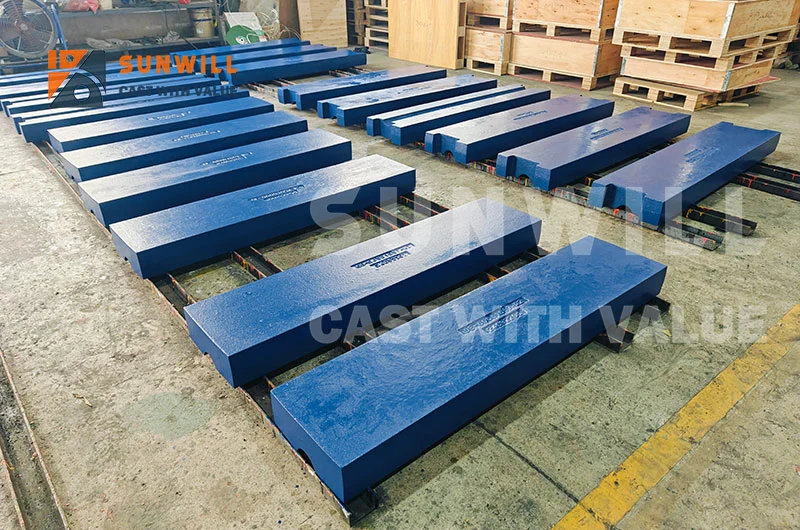
That mechanism is also the catch. Work hardening only happens if the feed actually impacts the bar with enough energy. In a low shock, high abrasion duty the surface never hardens, so the bar abrades away like soft steel. Manganese is therefore a specialist: superb where big feed and heavy impact trigger hardening, poor where fine, steady rubbing dominates.
Standard Mn13, Mn14 and Mn18 Hadfield grades are the common industry reference chemistry and appear across countless supplier catalogs. To be precise about scope: SUNWILL does not produce standard Hadfield manganese as a stock line. Our manganese family is built differently. We offer a TiC enhanced high manganese steel as an independent product line, described next, which embeds titanium carbide rods into the austenitic matrix to lift wear life well beyond plain manganese while keeping its impact character.
Typical applications: shot limestone, large feed primary crushing, and any duty where sufficient impact energy is guaranteed to trigger work hardening.
6. Manganese + TiC Composite
The manganese plus TiC bar pairs the high manganese matrix (greater than 250 HB as cast) with TiC carbide rods that test greater than 63 HRC. This is the architecture that lands in the best balance zone of the trade-off map.
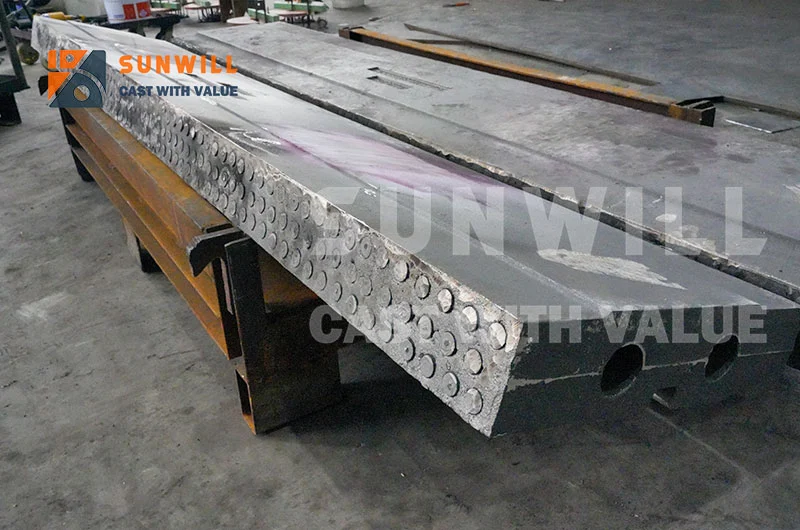
Here is why it matters. Plain manganese gives you impact toughness but, in mixed or low shock duty, gives up wear life. TiC rods embedded in the matrix act as ceramic grade hard phases that carry abrasion, while the manganese base still absorbs the big hits. You keep the “does not break” behavior of manganese and add the “does not wear” behavior of a ceramic reinforced part. For operations that see both large feed and high abrasion in the same shift, this is the candidate to beat.
Mini story: Carlos and the rebar gravel. Carlos Ramirez runs a recycling yard that processes river gravel laced with rebar contaminated concrete. His first bars were standard manganese, and on the abrasive gravel fraction they wore out in under two weeks because the load was not always impact driven enough to harden the surface. He then trialed a manganese plus TiC composite. The TiC rods carried the abrasive wear while the manganese base soaked up the occasional steel and boulder. Change out interval roughly doubled and unscheduled stops dropped sharply. Carlos did not get the absolute longest life of a pure ceramic bar, but he got the only material that survived both halves of his feed without fracturing.
Typical applications: large feed plus high abrasion combined duty, recycled aggregate with contamination, and mixed quarry feeds where a single alloy would fail on one extreme.
The Wear-Impact Trade-off: A Visual Framework
Every material decision comes down to one spectrum. As wear resistance climbs, impact resistance falls, because the microstructures that resist abrasion (hard carbides, ceramics) are the same ones that resist deformation and crack under shock. Reading the map below tells you where each of the six families sits.
MATERIAL WEAR RESISTANCE (left end) IMPACT RESISTANCE (right end)
High Chrome ████░░░░░░░░░░░░░░░░░░
High Chrome+Ceramic ████████░░░░░░░░░░░░░
Martensitic ░░░░░░████████░░░░░░░░
Martensitic+Ceramic ░░░░░██████████░░░░░░░
Manganese ░░░░░░░░░░░███░░░░░░░░
Manganese+TiC ████░░░░░░░███████████
The blocks are a relative positioning, not a measurement, but they capture the engineering truth.
- High Chrome stacks hard left. Maximum abrasion resistance, mid to low impact tolerance. Use it where shock is controlled.
- High Chrome + Ceramic pushes further left on wear while holding the same impact position as plain high chrome. The ceramic lifts wear life without making the bar more brittle.
- Martensitic centers the bar. Moderate wear resistance, moderate to higher impact tolerance. The balanced default.
- Martensitic + Ceramic shifts martensitic rightward on wear and keeps solid impact. A strong all rounder for mixed feeds.
- Manganese sits far right on impact but weak on the wear axis until it work hardens. Perfect for big shock, poor for steady abrasion.
- Manganese + TiC is the only family that reaches both ends. It scores left on wear via TiC and right on impact via manganese. This is the best balance zone, the second of our key insights: the ideal material resists both fracture and wear at once, and the TiC reinforced manganese is the closest production answer to that ideal.
To find your optimum point, plot your duty on the same spectrum. Estimate where your feed sits between pure abrasion (fine, hard, silica rich, screened) and pure impact (large, variable, tramp prone). Then pick the material whose block overlaps that point. If your duty sits at the extreme left, choose high chrome ceramic. If it sits at the extreme right, choose manganese or its TiC variant. If it sits in the middle, martensitic or martensitic ceramic is your answer.
Material Selection by Application Scenario (Summary Matrix)
The matrix below is a fast lookup. Material type and feed character point to a recommended family. For the full gating framework by feed size, use our blow bar selection by feed size guide, and for exact SUNWILL grade codes see B4: SUNWILL blow bar material codes.
| Feed scenario | Abrasion level | Impact level | Recommended family |
|---|---|---|---|
| Limestone, screened, low tramp | Low to medium | Low | High Chrome |
| River gravel, high silica | High | Low to medium | High Chrome + Ceramic |
| Granite, medium crushing | Medium | Medium | Martensitic |
| Concrete recycling, rebar present | Medium to high | Medium | Martensitic + Ceramic |
| Shot limestone, large boulders | Low | High | Manganese |
| Mixed gravel plus steel, variable | High | High | Manganese + TiC |
This summary intentionally stops at the family level. Detailed grade chemistry, heat treatment and dimensional codes live in B4 so this page stays the clean spec reference the rest of the series cites.
Cost-Per-Ton Analysis by Material Type
Purchase price is the worst lens for choosing a blow bar. The number that matters is cost per ton of material processed, and that depends on life, change out labor, downtime and scrap value. Here is the logic.
Plain high chrome and martensitic bars carry the lowest sticker price. Manganese is similarly modest. Ceramic and TiC composite bars cost more up front, often a meaningful premium, which is the reason many buyers hesitate. The error is stopping at the sticker.
A ceramic composite bar might cost two to three times a plain high chrome bar but last two to four times as long in abrasive duty. Change outs drop by half or more, which directly cuts labor hours, crane time and unplanned stoppages. In a high throughput quarry, a single avoided shutdown can outweigh the entire bar price difference. The wear rate per ton falls, so cost per ton falls even though cost per bar rose. This is the “buy expensive, use cheap” economics of composites.
Case example: the gravel pit that flipped the math. A Midwest gravel operation processing high silica sandstone switched from standard high chrome to high chrome plus ceramic bars. Plain bars needed replacement roughly every six weeks; ceramic bars stretched the interval past four months. Throughput per set rose and the wear rate per ton dropped. Even after paying the higher unit price, annual bar spend and downtime both fell, so cost per ton of finished aggregate dropped too. The higher quote stopped looking expensive the moment they divided by tons rather than by bars.
Tungsten carbide overlay bars, included here only as a comparison point, can deliver extreme local hardness but typically at the cost of complex application and brittle behavior under heavy shock, which is why SUNWILL references them for contrast rather than as a standard line.
This is where SUNWILL’s CAST WITH VALUE principle earns its name. CAST WITH VALUE means engineering the bar for lowest total cost of ownership, not lowest catalogue price. A ceramic or TiC reinforced bar that runs longer, breaks less and stops the line less often is the value, measured in tons, not in the first invoice. When you request a quote, ask for cost per ton modeling tied to your feed, not a per bar number in isolation.
Emerging Trends in Blow Bar Materials
The category is shifting faster than in past decades, driven by harder feeds and tighter margins.
Ceramic composites are gaining share. Market research values the broader ceramic composite wear resistant plate segment at roughly USD 1.94 billion in 2024, projected to about USD 3.09 billion by 2031 at a 7 percent compound annual growth rate. Within crusher wear parts, forecasts suggest ceramic composite solutions could climb from about 5 percent of the market toward over 20 percent by 2030 as abrasive feeds push operators past break even on premium bars.
TiC enhancement is going mainstream. Titanium carbide rod reinforcement lets manganese keep its impact toughness while gaining ceramic grade wear resistance, the balance zone this article highlights. Expect more grades to ship with embedded hard phases as standard rather than as an upgrade.
Customized formulations are rising. As ore bodies get harder and more variable, one size fits all chemistry loses ground to feed specific recipes that tune carbide volume, ceramic loading and heat treatment to a single quarry’s feed.
Digital selection tools are appearing. The wear impact map in this article is becoming software: feed analysis, crusher model and historical wear data feed a recommendation engine that names the material before the first bar ships. SUNWILL’s material code system in B4 is built to plug into that workflow.
Conclusion
You now hold the complete spec reference for blow bar materials. The six families span from high chrome at greater than 60 HRC through martensitic at greater than 53 HRC to manganese at greater than 250 HB, with ceramic and TiC variants lifting wear life without sacrificing the matrix’s impact character. The core lessons are simple to state and easy to forget: hardness is not the goal, balance is; ceramic and TiC raise the wear ceiling without making the bar more brittle; and no single material fits every duty.
Your next step is to map your own feed onto the wear impact spectrum and name the family that overlaps it. Then confirm the exact grade and code in B4: SUNWILL blow bar material codes, where the full chemistry and dimensional catalog lives. If wear patterns in your plant look wrong for the material you chose, our impact crusher wear troubleshooting guide will help you separate a material mismatch from a setting or feed problem.
Ready to spec the right bar for your feed? Explore the SUNWILL material code table and request a cost per ton quote built around CAST WITH VALUE, not catalogue price.
impact crusher apron gap setting## Standards and Authoritative References
- ASTM A532 / A532M-22(2022), Standard Specification for Abrasion-Resistant Cast Irons – the issuing body for the Ni-Hard Type 1/2/4 designations referenced in this article.
- ASTM A128 / A128M-19(2025), Standard Specification for Steel Castings, Austenitic Manganese – the governing specification for manganese steel grades (including Mn13/Mn14/Hadfield family) discussed in this article.
impact crusher side liners
Frequently Asked Questions
How do I compare HRC and HB when suppliers quote different scales?
You cannot read them as the same number. HRC (Rockwell C) measures shallow hardness on hard materials like high chrome and martensitic bars. HB (Brinell) averages over a wider area and suits ductile metals like manganese. As a rough guide, 60 HRC is about 650 to 700 HB, and 53 HRC is about 530 to 620 HB, while manganese at 250 HB sits near 25 to 30 HRC as cast but work hardens toward 450 to 500 HB. Always ask for the scale, and never rank a 350 HB manganese bar as “softer” than a 62 HRC chrome bar without accounting for work hardening and impact duty.
Will ceramic inserts really not crack under impact?
A well bonded ZTA ceramic honeycomb does not make the bar more brittle, which is the first key insight of this article. The ceramic carries abrasion on the wear face while the ductile metal matrix absorbs impact and holds the ceramic in place. Premium ZTA grades reach fracture toughness around 6 to 8 MPa m^0.5, well above plain alumina, and field trials report ceramic tiles staying bonded through hundreds of hours without loss. The failure mode to avoid is using a ceramic bar in a primary crusher with uncontrolled oversize or tramp steel, where even a tough matrix cannot protect it.
Why does manganese sometimes wear out fast?
Because it only hardens when impacted. Manganese steel sits at greater than 250 HB as cast and relies on work hardening to reach 450 to 500 HB at the surface. In a low shock, high abrasion duty the surface never hardens, so the bar abrades like soft steel. If your manganese bars wear quickly, check whether the feed is fine, steady and low impact. If so, you need a material that is hard from the start, such as high chrome or a ceramic composite, rather than a work hardening grade.
What is the difference between martensitic and high chrome blow bars?
Martensitic bars use Cr above 4 percent and C above 3.5 percent with a quenched and tempered matrix at greater than 53 HRC. High chrome uses Cr above 20 percent and C above 2.8 percent with a carbide skeleton at greater than 60 HRC. The chrome bar wins on abrasion but loses on impact toughness. Martensitic is the balanced middle option, tougher than chrome and more wear resistant than manganese. For a direct comparison of properties, life and cost see our martensitic versus high chrome breakdown.
Is high chrome or manganese better for blow bars?
Neither is universally better. High chrome beats manganese on wear resistance in low to medium shock duty such as limestone and clinker. Manganese beats high chrome on impact toughness where large feed and heavy shock are guaranteed. The right answer depends on your feed’s abrasion and impact profile, which is exactly what the wear impact map in this article helps you read.
What does TiC reinforced manganese offer over plain manganese?
Plain manganese gives excellent impact toughness but weak wear resistance unless it work hardens. TiC reinforced manganese embeds titanium carbide rods (greater than 63 HRC) into the manganese matrix, adding ceramic grade wear resistance while the base keeps its shock absorbing character. It is the family that reaches both ends of the trade-off map, making it the best balance candidate for mixed feeds that combine large impact and high abrasion in the same shift.