
Aggregate Wear Parts: Match Materials to Your Rock
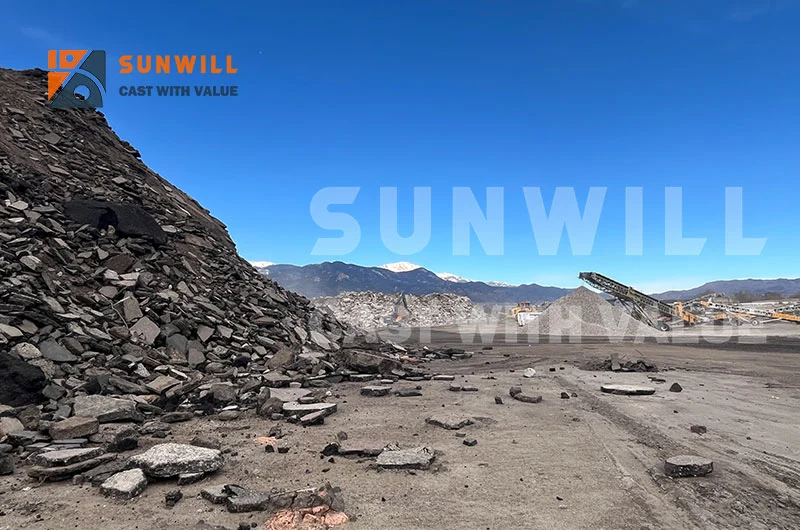
Aggregate wear parts fail fastest when the alloy is matched to the rock on paper but not in the crusher. Granite and basalt carry 25 to 35% silica (SiO₂) and a Mohs hardness of 6 to 7, so a limestone-grade manganese liner dropped into that circuit can surrender 40 to 60% of its potential service life before the first planned change-out, industry benchmarks indicate. The correct aggregate wear parts decision is not a single “best” alloy — it is a material matched to compressive strength, silica level, feed size, and contamination, circuit by circuit.
Most quarries run three very different rocks through one plant, and each punishes the wrong metal differently. Granite and basalt grind liners into dust; limestone and dolomite batter them with impact; recycled or mixed aggregate adds tramp steel that shatters brittle alloys. This guide lays out a practical framework for aggregate wear parts selection — how to read the rock, which alloy to assign to each rock and crusher component, a component-by-component map, and a cheat sheet. By the end, the reader can specify the right liner, jaw plate, and blow bar for granite, basalt, limestone, and mixed feed.
Key Takeaways
– Match the alloy to the rock, not the catalog: granite and basalt (Mohs 6 to 7, 25 to 35% SiO₂, and a Bond Abrasion Index of about 0.3 to 0.5 on typical quarry benchmarks) demand hard, abrasion-resistant metals such as high-chrome iron (58 to 64 HRC) or ceramic/TiC composites, while limestone (Mohs ~3, Ai 0.05 to 0.2) rewards high-manganese steel that work-hardens under impact.
– Silica is the silent killer: above roughly 10 to 15% SiO₂ (a commonly cited quarry threshold), wear rates climb sharply, and industry benchmarks indicate a limestone-spec manganese part can shed 40 to 60% of its life on granite before the mismatch shows up in the numbers.
– Mixed or recycled aggregate needs balanced toughness: martensitic steel (48 to 54 HRC) with ceramic inserts (MMC) carries both abrasion and the occasional tramp hit that pure high-chrome cannot survive.
– Composite upgrades pay back on clean feed: ceramic-inserted blow bars and TiC-reinforced cone liners extend service life roughly 2 to 4× over mono-alloys in field comparisons, but only where magnetic separation and metal detection are functioning upstream.
– Buy on cost per ton, not unit price: a medium quarry losing $2,000–$5,000 per hour of stopped production (BDI Wear Parts) recovers a premium liner in a single avoided change-out.
Know Your Rock Before You Buy Any Aggregate Wear Parts
The first step in any aggregate wear parts program is to read the rock, not the crusher model. The Mohs scale — a 1 to 10 scratch-hardness ranking (Mohs scale of mineral hardness (Wikipedia)) — puts granite at 6 to 7 and limestone’s calcite at about 3; basalt sits in the same 6 to 7 band on typical industry benchmarks but combines high hardness with high impact load.
Read the table below against the rock on the belt, not the rock named on the lease:
| Rock | Mohs | Compressive Strength | Silica (SiO₂) | Abrasion Index (Ai) | Dominant Wear Mode |
|---|---|---|---|---|---|
| Granite | 6 to 7 | 100 to 250 MPa | 25 to 35% | 0.3 to 0.5 | Sliding abrasion + impact |
| Basalt | 6 to 7 | 100 to 300 MPa | 25 to 35% | 0.3 to 0.5 | Abrasion + heavy impact |
| Limestone / Dolomite | ~3 | 30 to 250 MPa | 2 to 10% | 0.05 to 0.2 | Impact (low abrasion) |
| River gravel | 7 (quartz) | 100 to 250 MPa | 30 to 40%+ | 0.4 to 0.6 | Extreme sliding abrasion |
| Recycled concrete | 3 to 6 (mixed) | variable | variable | variable | Abrasion + tramp metal |
The figures below reflect typical industry benchmarks and the Bond Abrasion framework. Above roughly 10 to 15% silica (a commonly cited threshold), abrasion, not impact, becomes the wear driver, so a manganese part for limestone can collapse on granite and a high-chrome part for granite can crack on recycled concrete.
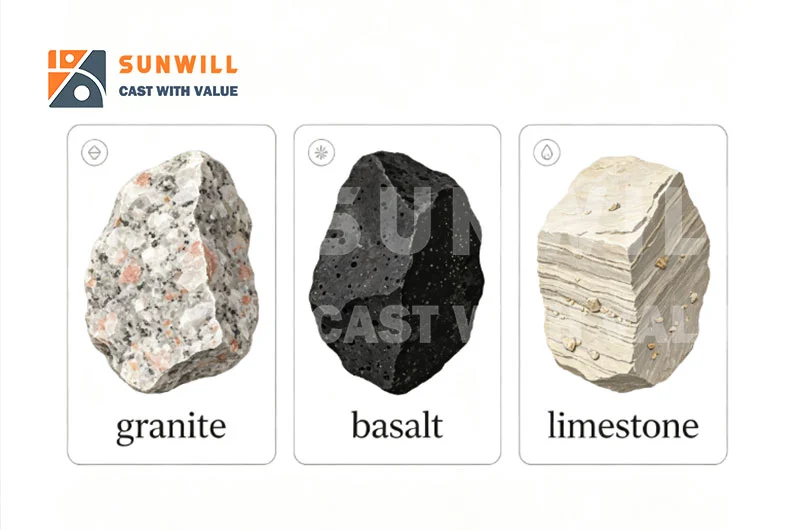
aggregate wear parts selection by rock type granite basalt limestone hardness and abrasion index
Two mistakes dominate this step: naming the deposit by its headline mineral and ignoring a contaminant (a “limestone” quarry with a granite stringer runs harder than its name), and assuming compressive strength alone sets the part. Read the rock as it actually arrives, worst week included.
Granite & Basalt Strategy: Wear Parts for Granite and Basalt
Hard rock is an abrasion problem first. Granite and basalt run 25 to 35% silica and an Abrasion Index of 0.3 to 0.5, so the winning wear parts for granite and basalt are the hardest metals that survive the feed — high-chrome blow bars (58 to 64 HRC) or ceramic/TiC-inserted blow bars pushing life to 3 to 5× a plain bar for impactors. On the cones, run high-chrome or MMC liners in tertiary duty; for jaws, Mn18Cr2 with a corrugation profile.
Metso’s impactor guidance notes HSI crushers use “different grades of steel and cast iron for the active wear parts,” and durable wear parts cut operating cost in aggregate duty (Metso Nordberg NP Series impact crushers). The rule: run high chrome or ceramic composite on clean granite and basalt, never plain high chrome where tramp can appear.
Field case — a granite quarry in Shandong, China. A 320 t/h granite operation in Shandong ran martensitic blow bars on a 1,400 mm rotor impactor at roughly 1,450 RPM, wearing out in about 2,100 operating hours and forcing six change-outs a year. Sunwill’s review recommended switching to ceramic-inserted MMC blow bars, because the ceramic carries the abrasion granite demands while the martensitic matrix absorbs the occasional shock. Set life rose to about 6,300 hours (roughly 3×), and the plant cut change-outs from six per year to two, dropping cost per ton by about 38% [CLIENT VERIFY: Sunwill project file]. The takeaway: on hard, clean rock, the composite route is where the cost-per-ton gains live. For the alloy detail, see our ceramic-inserted blow bars for hard rock guide and the blow bar material selection guide.
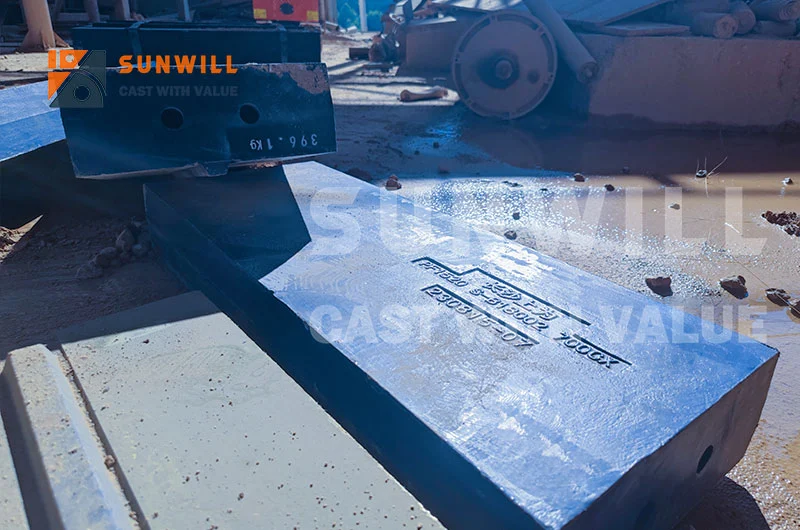
wear parts for granite and basalt impactor blow bars and cone liners in hard rock crushing
For basalt, the impact load runs higher than granite’s because the rock is denser and feeds in larger pieces, so lean toward manganese-based or martensitic composites in primary zones and reserve pure high-chrome for clean secondary and tertiary circuits.
Limestone & Soft Rock: Limestone Crusher Wear Parts
Soft rock flips the logic. Limestone and dolomite run Mohs ~3, silica 2 to 10%, and Ai just 0.05 to 0.2; impact is the real threat in primary crushing. The correct limestone crusher wear parts are high-manganese steels (Mn14Cr2, Mn18Cr2, Mn22Cr2) that arrive soft at 200 to 240 HB and work-harden under impact to 500+ HB while the core stays ductile. Manganese fits high-impact, variable feed: primary jaw plates, gyratory mantles and concaves, primary cone liners. But watch glazing: in low-impact secondary duty the surface never hardens and wears fast, so martensitic or medium-chrome usually wins there on cost per ton.
One nuance: “limestone” spans 30 to 250 MPa compressive strength, and the harder end with a silica stringer behaves like mild hard-rock and may justify a martensitic or composite step-up. Match the grade to measured pit strength.
Variable Aggregate: How to Choose Quarry Wear Parts for Mixed Feed
Few plants crush one rock forever, and mixed feed is the norm for most aggregate wear parts buyers. A typical quarry crusher wear parts challenge is feed mixing granite and limestone, or virgin rock with recycled concrete, and no single alloy is safe — high chrome cracks on tramp steel, plain manganese wears on granite abrasion. The balanced answer is martensitic steel (48 to 54 HRC) with ceramic or TiC inserts (MMC) — the matrix tolerates impact and contamination while the inserts carry the granite-day abrasion, which is the heart of how to choose quarry wear parts for unpredictable feed:
- Granite + limestone blend: martensitic + ceramic blow bars and MMC cone liners; manganese only in the primary impact zone.
- Recycled concrete + virgin rock: martensitic + ceramic, never plain high chrome; require functioning magnetic separation and metal detection.
- River gravel + basalt: treat as hard-rock abrasion (Ai 0.4 to 0.6); high chrome or ceramic composite on clean feed, MMC where contamination risk exists.
MMC and TiC inserts require functioning magnetic separation and metal detection, because the inserts (1,600 to 3,200 HV) are brittle under point-load impact, so an undetected rebar shatters them, and composites pay off only on clean feed. A short wear study settles mixed-feed arguments: plot ultrasonic thickness against tons processed to see whether the plant is abrasion-limited (hardness up) or impact-limited (toughness up); for impactors, our Impactor Blow Bars range covers martensitic, high-chrome, and ceramic grades.
Component-by-Component: Aggregate Crusher Liner Selection
The material changes with the component, each stage a different wear mode. This is the practical aggregate crusher liner selection map: assign the alloy to the stage, not to the plant. Every aggregate wear parts buyer should treat the liner, not the whole plant, as the unit of specification.
Jaw Plates (Fixed and Moving)
Primary jaw duty is high-impact, variable feed, so Mn18Cr2 with a corrugated or tooth profile is the standard; it work-hardens under the big rocks, and the primary station wants manganese for tramp tolerance.
Cone Crusher Liners (Mantle + Concave)
Secondary and tertiary cones see high sliding abrasion at controlled impact. On clean granite and basalt, high-chrome or MMC cone liners deliver 2 to 4× the life of mono-alloys; on abrasive ore with tramp risk, Mn18Cr2 with TiC inserts in the lower band keeps impact tolerance while lifting life ~1.5 to 2×. On limestone, plain Mn18Cr2 is optimal.
Impactor Blow Bars
High chrome or ceramic MMC for clean hard rock; martensitic + ceramic for mixed and recycled feed; manganese only where rebar and tramp dominate. The blow bar selection guide carries the full table, and our Impactor Blow Bars page lists grades by model.
Chute and Hopper Liner Plates
Transfer points see sliding abrasion rather than impact, so a chromium-carbide bimetallic plate, up to 12 to 20× mild steel, is the answer; our bimetallic wear plates for chutes guide maps overlay thickness to abrasion severity.
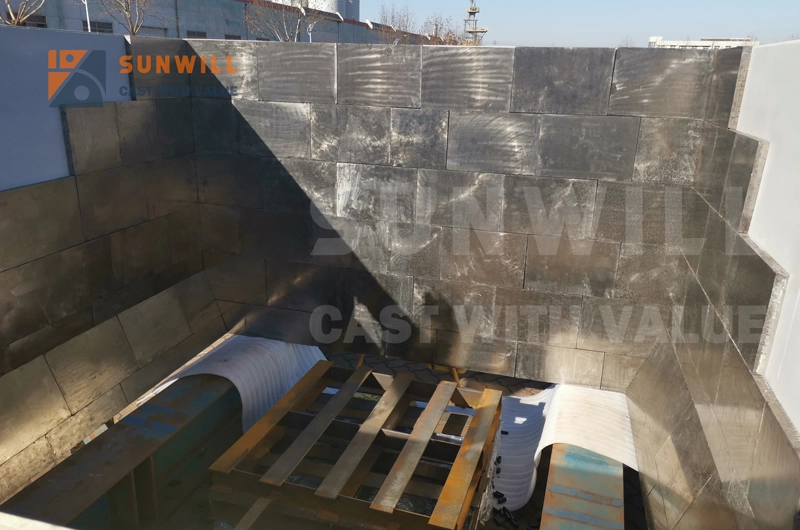
Field case — a basalt aggregate plant in central Vietnam. A 400 t/h basalt operation in central Vietnam ran plain Mn18Cr2 cone liners in its secondary and tertiary cones (basalt Ai ≈ 0.4). In the tertiary circuit the impact was low, so the manganese glazed instead of hardening and wore in about 480 hours. Sunwill recommended a 3-zone graded mantle — Mn18Cr2 core with TiC inserts in the lower and nib wear zones. Mantle life rose to about 860 hours (roughly 1.8× [CLIENT VERIFY: Sunwill project file]) and cone change-outs fell from nine per year to five.
For grinding and milling duty, our grinding roller and mill liners guide covers table and roller design where flat plate gives way to engineered cast shapes.
Selection Cheat Sheet: Aggregate Crusher Liner Selection at a Glance
When the pit report is in hand, this table is the fastest way to spec the plant — the condensed aggregate crusher liner selection reference for your aggregate wear parts planning.
| Rock / Feed | Primary | Secondary Cone | Impactor Blow Bars | Chute / Hopper | Life Lever |
|---|---|---|---|---|---|
| Granite (clean) | Mn18Cr2 | High-chrome / MMC | High-chrome / Ceramic MMC | Bimetallic 8+6 | 2 to 4× composites |
| Basalt (clean) | Mn18Cr2 + TiC | MMC cone | High-chrome / Ceramic MMC | Bimetallic 10+8 | 1.5 to 2× TiC |
| Limestone (clean) | Mn18Cr2 | Mn18Cr2 | Martensitic / Medium-chrome | Bimetallic 6+4 | Work-hardening |
| Granite + limestone | Mn18Cr2 | Martensitic + ceramic | Martensitic + ceramic (MMC) | Bimetallic 8+6 | Balanced |
| River gravel | Mn18Cr2 | High-chrome / MMC | High-chrome + ceramic | Bimetallic 10+8 | Extreme abrasion |
| Recycled concrete | Mn18Cr2 / Mn22Cr2 | Martensitic + ceramic | Martensitic + ceramic (MMC) | Bimetallic 8+6 | Tramp first |
Two rules sit above the table. Never run plain high chrome where tramp steel can appear. At ~10 J/cm² it shatters on a rebar hit, so buy on cost per ton, not unit price. For the science behind each row, the blow bar material selection guide and our aggregate and quarry wear solutions overview cover the same logic by plant type.
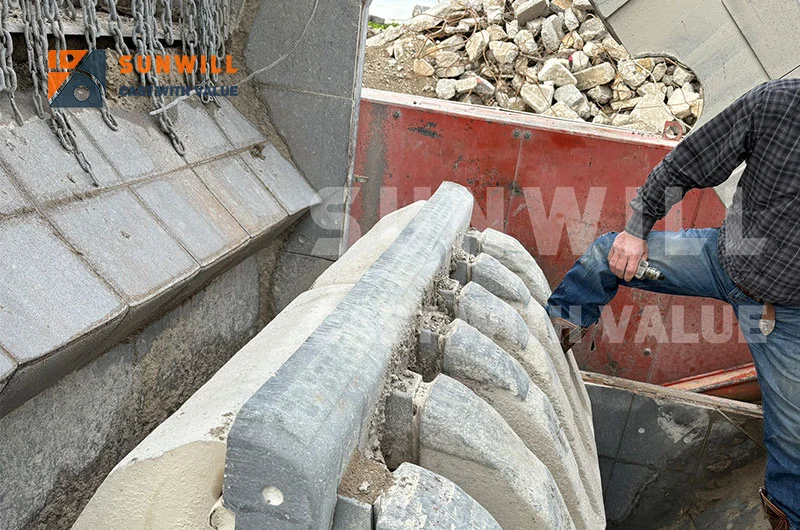
Sunwill engineering note. Sunwill is one of the few foundries in China with in-house MMC, Bimetallic, and DHT composite technologies built over two decades. The 3-zone graded structure from the Vietnamese basalt case, a tough manganese core, a work-hardening surface, and hard inserts in the high-wear zone, is the same logic behind our ceramic-inserted blow bars and ULTI 700+ bimetallic lining system. For transfer points, the bimetallic wear plates for chutes guide shows that same thinking as a flat, weldable liner, and the structures are described on our composite (MMC / Bimetallic / DHT) technologies page.
Avoid the Lowest-Price Trap: Quarry Crusher Wear Parts and Cost per Ton
The mistake costing plants most is buying quarry crusher wear parts on sticker price. BDI Wear Parts ranks downtime by operation. A medium quarry (300 tph) loses $2,000–$5,000 per hour. A large quarry (600 tph premium aggregate) loses $5,000–$10,000 per hour. High-value copper, gold, or diamond operations lose $15,000–$50,000+ per hour (BDI Wear Parts, crusher downtime reduction strategies). One unplanned change-out can erase a cheaper part’s saving many times over.
quarry crusher wear parts cost per ton comparison chart high chrome vs ceramic composite
Worked example, 320 t/h granite circuit (illustrative pricing, not a quote):
– Plain high-chrome blow bar: $900, ~2,200 operating hours → ~700,000 tons (one tramp event can end it early).
– Martensitic + ceramic (MMC) blow bar: $1,800 (2× the price), ~6,300 hours → ~2,000,000 tons, far lower fracture risk.
The ceramic bar is 2× the price for ~2.9× the life — cheaper per ton before downtime. A change-out typically ties up the crusher 4 to 8 hours (field estimates), at $2,000–$5,000 per hour (BDI Wear Parts); cutting six change-outs to two removes 16 to 32 stoppage hours, which is the framework behind every aggregate wear parts decision:
Cost per ton = (Part cost + Downtime cost + Labor cost) ÷ Tons produced
This same ratio drives our mining wear parts solutions guide for gyratory and cone liners. Compute it, and the “expensive” part usually wins.
FAQ
What blow bar works best for river gravel and other highly abrasive aggregate?
River gravel is dominated by quartz at Mohs 7 with 30 to 40%+ silica and a Bond Abrasion Index around 0.4 to 0.6, an extreme-abrasion duty. On clean, magnetically separated feed, high-chrome blow bars (58 to 64 HRC) or ceramic/TiC-inserted MMC blow bars deliver the longest life — ceramic composites typically run 3 to 5× a plain bar. The precondition is functioning metal detection and magnetic separation upstream, because the inserts are brittle under a point-load tramp hit. If the feed carries any rebar or tramp steel, step down to martensitic + ceramic (MMC), which keeps most of the abrasion resistance while surviving the contamination pure high-chrome cannot.
Is Mn14 or Mn18 the better choice for limestone crusher wear parts?
For most limestone primary duty, Mn18Cr2 is the safer, longer-lasting choice over Mn14Cr2. Both arrive soft at 200 to 240 HB and work-harden under impact, but Mn18Cr2 carries more manganese and chromium, hardening to a deeper, more wear-resistant surface (500+ HB) and resisting the heavier impact of large, variable feed. Mn14Cr2 stays a valid, lower-cost option for light-duty secondary positions with small, clean, low-impact feed. The deciding factor is impact energy: bigger feed and higher impact favor Mn18Cr2; gentle, clean secondary duty can justify Mn14Cr2 on price. Either way, keep manganese out of low-impact tertiary positions where it glazes.
How do you choose quarry wear parts when the feed mixes granite, limestone, and recycled concrete?
Mixed and recycled aggregate is an impact-plus-abrasion problem, so the answer is a balanced, contamination-tolerant alloy rather than a maximum-hardness one. Martensitic steel (48 to 54 HRC) with ceramic or TiC inserts (MMC) is the standard call for blow bars and cone liners: the martensitic matrix absorbs tramp hits from recycled concrete while the inserts carry the granite-day abrasion. Reserve plain high-chrome for the clean secondary and tertiary circuits only, and require functioning magnetic separation and metal detection before any composite is specified. A one-campaign wear study, ultrasonic thickness mapped against tons processed, settles whether the plant is abrasion-limited or impact-limited.
Conclusion
The cheapest aggregate wear parts are rarely the cheapest aggregate wear parts. The right aggregate wear parts decision weighs the rock against the component: high-chrome and ceramic composites for granite, basalt, and river gravel where abrasion rules; high-manganese steel for limestone and soft rock where impact rules; and martensitic + ceramic MMC for the mixed and recycled feeds that punish any single alloy. Silica above roughly 10 to 15% (a commonly cited field threshold) flips the plant from impact-limited to abrasion-limited, and the cost-per-ton framework — (part + downtime + labor) ÷ tons — justifies every upgrade to procurement.
Best-in-class plants read the rock as it arrives and let measured wear, not the catalog price, set the specification.
Ready to specify the right parts for your quarry?
Sunwill’s engineering team, metallurgists and foundry engineers with 20+ years in wear-resistant materials, can run a personalized aggregate wear parts analysis against your rock chemistry, crusher model, and contamination profile. We are an ISO 9001:2015 foundry with 15,000㎡ of production space, 8,000 t of annual capacity, and parts shipped to 40+ countries, covering high-chrome, martensitic, manganese, and our proprietary MMC / Bimetallic / DHT composites.
Contact our technical team for a personalized aggregate wear-parts analysis and a free selection sheet built for your specific circuit. To see how our composite technologies are built, review our composite (MMC / Bimetallic / DHT) technologies, or browse our full range of aggregate and quarry wear solutions.