
Bimetallic Wear Plates for Chutes & Hoppers: The Complete Chromium Carbide Guide
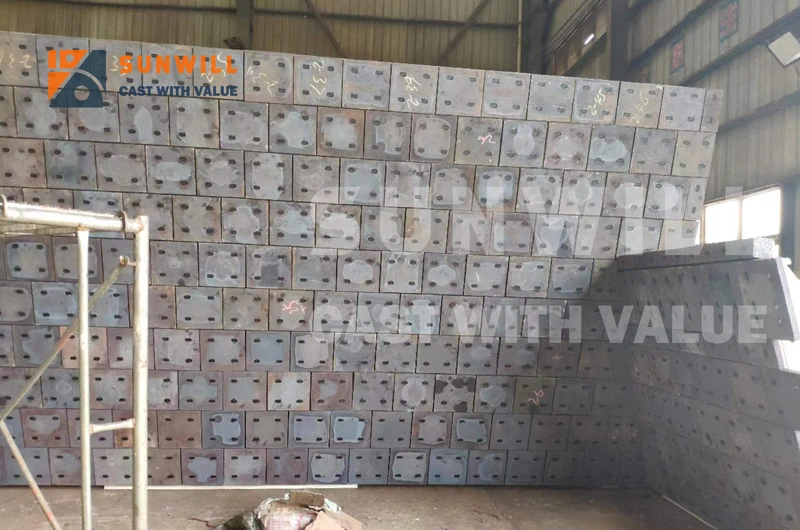
A bimetallic wear plate — a chromium-carbide composite liner built from a mild-steel base and a hard high-chrome overlay — outlasts mild steel by up to 12–20× in sliding-abrasion duty (about 3–6× beyond AR400). Most plants never put a number on it. The humble transfer point is one of the most overlooked downtime sources in any crushing, conveying, or material-handling circuit. Crusher stoppages grab the headlines. BDI Wear Parts cites $15,000–$50,000+ per hour in lost output at high-value mines . But the chute liner that wears through on a Sunday shift costs the same lost tons, just in smaller, less-visible bites.
Most plants have lived this pattern: a mild-steel or AR400 liner goes in, runs a few months, then a thin spot appears, then a hole, then a shutdown to weld in a patch. Multiply that across a plant’s dozens of transfer points and the liner-change hours add up to real money. A chromium-carbide composite plate flips the math — one installation that runs years instead of months.
This guide covers the metallurgy in plain language, a thickness table mapped to abrasion duty, a life comparison against AR steel, field cases from mining, cement, and power, and the fabrication rules that keep a liner in service for years. By the end you will know exactly which overlay thickness to specify for a chute or hopper, how to attach it, and why those small surface cracks after welding are normal — not failure. For the wider wear strategy across your plant, our mining wear parts solutions guide connects liner life to crusher downtime and cost per ton.
Key Takeaways – A bimetallic wear plate lasts up to 12–20× longer than mild steel (about 3–6× beyond AR400) in sliding-abrasion duty, because a surface of chromium-carbide (Cr₇C₃) hardfacing at HRC 58–62 carries the wear while a mild-steel base carries the impact and weldability. – Overlay thickness sets the duty ceiling: 3–4 mm for light abrasion, 5–6 mm medium, 8–10 mm heavy (crusher discharge, clinker), and 12–20 mm for extreme primary hoppers — the “6+4” and “8+6” designations mean base-plus-overlay millimetres. – AR400 is only 3–5× mild steel, and a plain weld overlay 4–6× — both are blown away by the 12–20× of a properly specified chromium-carbide plate (versus mild steel), so buy on cost-per-ton, not plate price. – Small stress-relief cracks at the weld are expected and harmless — the hard overlay and soft base expand at different rates; the cracks arrest in the base layer and do not propagate through the plate. – Attachment is by counterbore bolts, plug welds, or perimeter welding — the plate cannot be machined and must be cut by plasma or waterjet, so design holes and shapes in before fabrication.
What Is a Bimetallic Wear Plate?
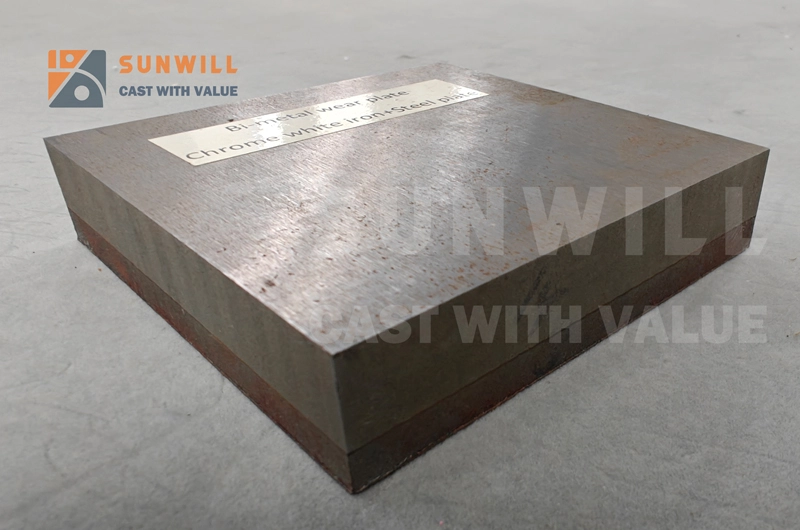
A bimetallic wear plate is two metals in one product, metallurgically bonded so they act as a single liner. The backing is a low-carbon structural steel, typically Q235 or Q345 in Chinese mill grading (the equivalents of A36 or S355). It is chosen for toughness, weldability, and the ability to absorb impact without cracking. Fused to its surface is a hardfacing layer of high-chromium alloy, usually 25–40% chromium with a few percent carbon, deposited by submerged-arc welding or open-arc welding in multiple passes.
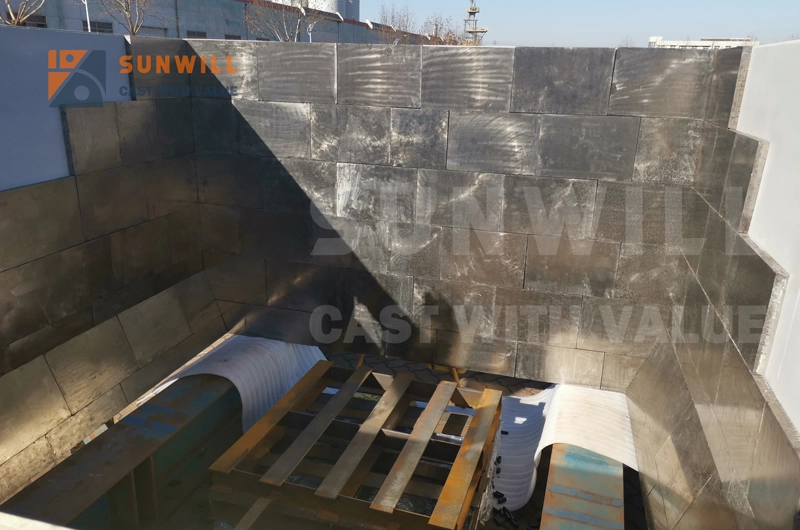
The magic is in what the hardfacing becomes as it solidifies. The carbon and chromium combine into chromium carbides — predominantly Cr₇C₃ — that grow as hard, angular particles embedded in a tougher alloy matrix. Those carbides run about 1,200–1,800 HV (roughly HRC 58–62), far harder than any through-hardened abrasion-resistant steel. Because the carbides sit at the working surface and the tough steel sits underneath, the plate resists both sliding wear and impact — the combination that pure hardfacing or pure AR steel each handle poorly on their own.
Three things distinguish a true bimetallic plate from its cheaper cousins:
- Weld-overlay plate (single-alloy base): a chromium-carbide layer deposited on a plain steel plate. This is the category most “wear plate” products fall into, and it performs well — but a purpose-built bimetallic grade optimizes the base chemistry for bonding and impact, so the two layers behave as one.
- Through-hardened AR steel (e.g., AR400/AR500): hard all the way through at ~400–500 HBW, but no carbides. It loses its edge fast once the surface is breached, and it cannot match carbide hardness.
- Cast chromium-carbide liners: the same carbide logic in a thicker cast form, but less formable and harder to fit into tight chute geometry.
For measuring and ranking these materials, the industry reference is the ASTM G65 dry sand/rubber wheel abrasion test, which reports wear as volume loss in cubic millimetres — lower volume loss means higher abrasion resistance (ASTM G65 abrasion test standard). Chromium-carbide overlays post among the lowest volume-loss figures of any flat wear material, which is exactly why they dominate sliding-abrasion transfer points.
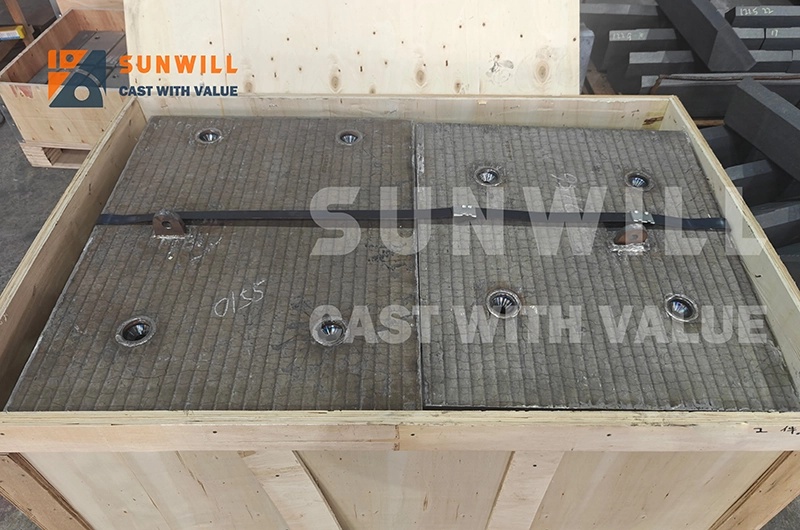
A quick word on language: “bimetallic wear plate,” “chromium carbide wear plate,” and “chrome carbide overlay plate” all describe this same family — a CCO (chromium carbide overlay) wear plate, also called a chrome carbide overlay plate, is simply the bimetallic product named for its hardfacing. When you see a designation like 6+4 or 8+6, the first number is the mild-steel base thickness and the second is the carbide overlay thickness in millimetres; a chromium carbide plate thickness 6+4 8+6 notation means you are choosing between a 6 mm base + 4 mm overlay (10 mm total) and an 8 mm base + 6 mm overlay (14 mm total). We will map those numbers to duty next.
Overlay Thickness Selection
For a bimetallic wear plate, the single most common specification error is buying too thin. The overlay is the only part doing the wearing — once it is gone, the mild-steel base erodes in days, not years. So thickness selection is really overlay selection, and it should track the severity of the sliding abrasion at your transfer point.
A practical rule of thumb used across the wear-plate industry:
- Light duty (overlay 3–4 mm): free-flowing, low-abrasive, or low-throughput material — grain, fertilizer, wood chips, fly ash, fine coal.
- Medium duty (overlay 5–6 mm): steady abrasive flow — aggregate transfer, limestone, sand, general ore chutes at moderate tonnage.
- Heavy duty (overlay 8–10 mm): aggressive sliding abrasion with some impact — crusher discharge chutes, cement clinker chutes, hard-rock transfer points, primary screening.
- Extreme duty (overlay 12–20 mm): maximum abrasion plus heavy impact or high tonnage — primary dump hoppers, grizzly discharge, high-capacity hard-ore transfer, stacker-reclaimer boom casings.
| Overlay Thickness | Typical Total Plate (base+overlay) | Abrasion Duty | Representative Applications |
|---|---|---|---|
| 3–4 mm | 4+3, 5+3, 6+3 (7–9 mm) | Light | grain/fertilizer chutes, fly-ash lines, low-duty transfer |
| 5–6 mm | 6+4, 8+4, 8+5 (10–13 mm) | Medium | coal handling, aggregate transfer, ore chutes (moderate t/h) |
| 8–10 mm | 8+6, 10+8 (14–18 mm) | Heavy | crusher discharge, clinker chutes, hard-rock transfer, screening |
| 12–20 mm | 10+10, 12+12, 15+15 (20–30 mm) | Extreme | primary dump hoppers, grizzly discharge, high-t/h hard ore |
Note the notation again: a chrome carbide overlay plate (often shortened to a CCO wear plate) marked 6+4 carries a 4 mm carbide layer — enough for medium duty — while 8+6 carries a 6 mm layer for heavy duty. The base thickness matters too: a thicker base resists impact denting and gives more weld cross-section for attachment, so don’t starve the base to save weight.
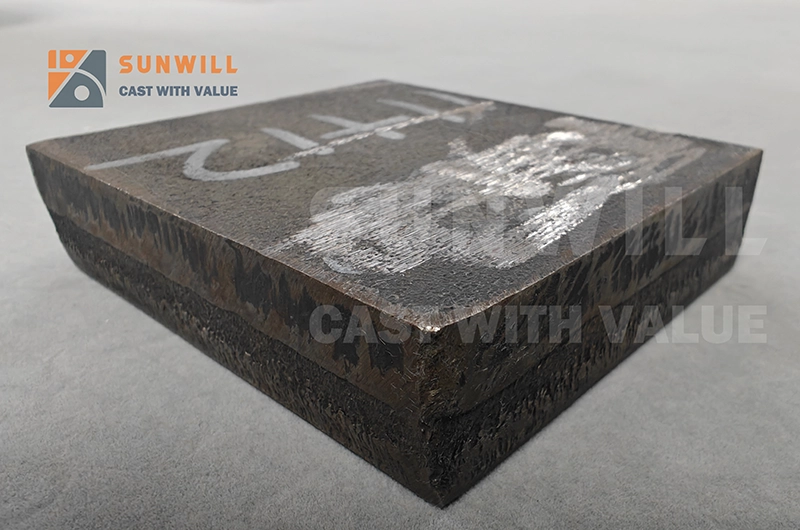
One subtlety engineers miss when specifying a bimetallic wear plate: the carbide volume fraction and the through-thickness carbide continuity matter as much as the nominal overlay number. A quality plate holds its hardness and carbide density down to roughly 75% of the overlay depth, so the “effective” wear layer is a bit less than the stamped figure. That is why a 6 mm overlay realistically delivers 4–5 mm of full-protection life — plan the thickness with that margin in mind. When in doubt, step up one duty class rather than one down; the incremental plate cost is trivial against a single unplanned chute shutdown.
Bimetallic Wear Plate vs AR Steel vs Plain Overlay
The life multiples below are representative field ranges for sliding-abrasion duty — the dominant wear mode in chutes and hoppers — relative to plain mild steel as the 1× baseline. Your exact numbers shift with material abrasiveness, throughput, and impact, but the ranking is stable across plants.
Bimetallic Wear Plate vs AR400 Steel: Life Comparison
| Material | Surface Hardness | Relative Life (sliding abrasion) | Why |
|---|---|---|---|
| Mild / low-carbon steel (Q235) | ~120–150 HB | 1× (baseline) | No hard phase; erodes steadily |
| AR400 abrasion-resistant steel | ~400 HBW (≈40 HRC)* | 3–5× | Through-hardened but no carbides |
| AR500 abrasion-resistant steel | ~500 HBW (≈50 HRC)* | 4–6× | Harder, still no carbide phase |
| Plain weld overlay / chrome liner | ~55–60 HRC | 4–6× | Carbides present, thinner/less optimized |
| Chromium-carbide bimetallic wear plate | HRC 58–62 (Cr₇C₃) | 12–20× | Dense surface carbides + tough bonded base |
*AR400/AR500 nominal hardness per SSAB’s Hardox grade data, where Hardox 400 runs 370–430 HBW and Hardox 450 adds about 50 HBW over standard AR400 grades (SSAB Hardox product program).
The blunt reality of the AR400 vs bimetallic comparison: AR steel is a respectable 3–5× upgrade over mild steel, but it is still an order of magnitude shy of a chromium-carbide plate. A bimetallic plate does not just last longer — it changes the maintenance rhythm from “patch every quarter” to “inspect every couple of years.”
Field case — a copper mine in Peru’s copper belt. A mid-size copper operation was lining its primary crusher discharge chutes with AR400 plate and changing them roughly every 14 weeks — about 3.7 changes a year across a dozen transfer points, each a half-shift shutdown plus a welding crew. Sunwill’s application review recommended switching the heavy-duty points to an 8+6 chromium-carbide bimetallic wear plate and the medium points to 6+4. The AR400 liners that had been wearing through in ~14 weeks ran past 18 months before the first ones needed rotation. The maintenance planner’s own tally: change-outs dropped from roughly 44 per year to under 8, recovering the plate premium several times over in crew hours and avoided stoppage alone. The lesson is the same one we drew in the blow bar material selection guide: the “expensive” wear part usually wins once you price in downtime, not just the invoice.
For plants also running impact crushers, the composite logic is identical — our ceramic-inserted blow bars for hard rock carry the same hard-phase-over-tough-base thinking into the rotor.
Application Map: Where Chromium Carbide Plates Earn Their Keep
A wear plate for chutes and hoppers duty is not one product — it is a family of bimetallic wear plate options matched to the material moving through. The map below covers the five duty zones where bimetallic liners pay back fastest.
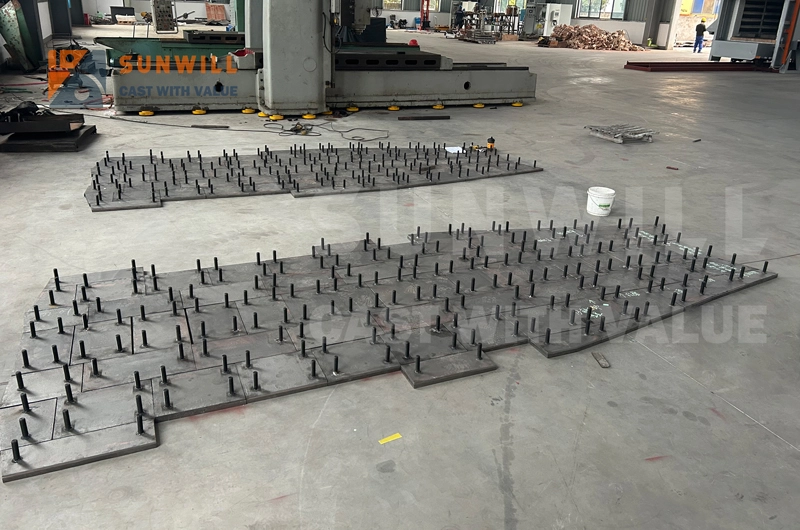
1. Mining chutes and ore transfer. Hard, angular, high-tonnage ore is the harshest sliding-abrasion environment there is. Primary dump chutes and crusher-feed chutes want the extreme-duty 12–20 mm overlay; secondary screening and conveyor transfer points sit comfortably at 8–10 mm. This is where the 12–20× multiple versus mild steel shows up as months-to-years of extra life.
2. Crusher discharge and screen undersize. Material leaving a crusher is sharp-edged and fast-moving. A bimetallic liner for conveyor transfer at the crusher discharge takes both abrasion and impact, so a thicker base (8 mm+) under a 6–10 mm overlay is the right call. Plants in our quarry and aggregate wear-parts selection guide routinely standardize this zone on chromium carbide.
3. Cement clinker chutes. Clinker is hot, coarse, and brutally abrasive. On the post-cooler transfer, a 10+8 or 12+10 bimetallic liner typically runs 2–3 years, and because the clinker is still hot (see the temperature note in the FAQ), the carbide overlay’s heat tolerance matters here more than almost anywhere else.
4. Power-plant coal handling. Coal itself is moderate abrasion, but the tonnage is enormous and the conveyors run continuously. Coal chutes, bunker transition sections, and tripper rooms wear through on volume. Medium-duty 6+4 or 8+4 liners cut change-outs dramatically and keep the unit feeding the boiler without interruption.
5. Ports, stackers, and reclaimers. Ship-loaders, stacker-reclaimer boom casings, and yard conveyor transfers move millions of tonnes of iron ore, coal, or aggregates. A bimetallic liner for conveyor casings at these points is often the difference between a planned annual reline and constant patch welding.
Field case — a cement plant in northern Vietnam. A 4,500 t/day clinker line was replacing its preheater and kiln-feed chute liners — mild-steel plate — every four months, each change a forced stoppage that throttled kiln feed. The maintenance team swapped the worst zones to a 10+8 bimetallic wear plate and the cooler-discharge transfer to 8+6. The mild-steel liners that had lasted ~4 months now run past 30 months, and the plant folded the remaining chute work into its annual kiln shutdown instead of emergency patches. Beyond the liner saving, the steadier feed cut a recurring source of kiln upsets. The same pattern shows up wherever clinker or sinter moves: the carbide surface outlasts the plant’s own maintenance calendar.
Field case — a coal-handling terminal on the Yangtze. A 20 Mt/year coal terminal was patching its stacker-reclaimer boom casings and transfer house chutes almost monthly with AR plate. Switching the high-wear casings to 8+6 bimetallic liners and the house chutes to 6+4 cut the patch-welding crew’s chute workload by roughly 80%. The terminal’s reliability engineer noted the bigger win was predictable planning: liner inspection became a scheduled annual item rather than a weekly fire drill. For operations moving this kind of tonnage, the mining wear solutions overview and our material-handling range cover the full liner scope from pit to ship.
Attachment & Fabrication
A bimetallic wear plate is tough in service but unforgiving in the shop. Get the fabrication rules wrong and you waste the life you paid for. Four rules cover almost everything.
1. Cut only with thermal or abrasive methods. The carbide face cannot be sheared or sawn cleanly, and a shear will shatter the overlay. Use plasma, laser, or waterjet cutting. For field work, oxy-fuel works on thicker plates but leaves a harder heat-affected edge that should be dressed. Never attempt to punch or shear the plate.
2. Attach by one of three proven methods. – Counterbore bolts: drill a countersink from the carbide side, through-bolt from the back, and cap the bolt head with a weld bead flush to the surface. Best for liners that must be removable. – Plug welds: weld a mild-steel plug into a hole burned through the plate, fusing it to the substrate. Simple and strong for permanent liners. – Perimeter (continuous) weld: weld the plate edge to the substrate around the full perimeter. Use for large, permanently fixed liners where full bonding matters.
3. Do not machine the carbide face. This is the rule that traps first-time users. The hard phase cannot be drilled, tapped, or milled — any hole or shape must be cut before the plate is installed, or created by plug welding a mild-steel insert you can then drill. The mild-steel base side, once exposed, can be drilled and tapped normally.
4. Mind the base, not just the face. Because the base of a bimetallic wear plate is weldable low-carbon steel, fabrication and attachment happen on that side. Design your bolt holes, lifting lugs, and mating geometry into the base before the overlay goes on, and confirm the substrate you are welding to is clean and dry.
For the grinding and milling side of the same plants, our grinding roller & mill liners guide covers liner profiles where flat plate gives way to engineered cast shapes.
Why Stress-Relief Cracks Are Normal
The first time a fitter sees a freshly welded bimetallic wear plate, the instinct is to reject it. Small cracks appear along the weld line and sometimes spider across the carbide surface. Here is the reassuring truth: those cracks are normal, expected, and not a defect.
They form because the hard carbide overlay and the soft mild-steel base have very different coefficients of thermal expansion. As the plate cools after welding — or heats and cools in service — the two layers want to move by different amounts. The carbide layer, being brittle, relieves that stress by cracking in a controlled way. Critically, the cracks arrest in the tough base layer and cannot propagate through the bimetallic wear plate. This crack-arresting behavior is built into the design; it is why the base steel is there in the first place.
Sunwill ULTI 700+ Lining System
For plants that want the bimetallic advantage without specifying every plate by hand, Sunwill offers the ULTI 700+ Lining System — a custom-fabricated bimetallic wear plate program built specifically for chutes, hoppers, and conveyor transfer points. The “700+” refers to the carbide surface hardness in HV (approximately HRC 58–62), the same chromium-carbide performance described throughout this guide, delivered as engineered liner kits rather than raw plate.
Sunwill engineering note. Sunwill is one of the few foundries in China with in-house MMC, Bimetallic, and DHT composite technologies developed over two decades of wear-parts production. The ULTI 700+ system applies our bimetallic logic — a tough bonded base under a dense chromium-carbide wear face — to flat and curved chute geometry, pre-cut, pre-drilled, and delivered as bolt-in kits matched to your transfer-point drawings. For the casting side of the same thinking, our Wear Plate product page shows the standard plate range, while our composite (MMC/DHT) technologies explains how the hard-phase-over-tough-base principle scales from plates to blow bars to gyratory liners. Every ULTI 700+ order starts with an application review — material abrasiveness, throughput, impact, and temperature — so the overlay thickness and base grade match the duty, not a catalog default.
Because the system is custom-fabricated, you get the right thickness in the right zone: thin 6+4 liners in low-wear corners, heavy 12+12 plates in the impact zone, and pre-cut holes so your crew bolts them in during a planned window. That is the difference between “we bought a bimetallic wear plate” and “we solved the chute.”
FAQ
Can bimetallic wear plate be drilled or machined? No — not the carbide face. The chromium-carbide overlay is too hard to drill, tap, or mill, and attempting it will shatter the hard phase. Any hole or threaded feature must be cut before installation (by plasma or waterjet) or created by plug-welding a mild-steel insert into a burned hole and then drilling that insert. The mild-steel base side, once exposed, machines and taps normally, which is why all fabrication and attachment happen from the base.
What is the maximum service temperature for chromium-carbide wear plate? A chromium-carbide overlay is rated for continuous service around 350°C (≈660°F), and can tolerate intermittent peaks up to roughly 500°C (≈930°F) with some life reduction. Above about 500–600°C the Cr₇C₃ carbides begin to dissociate and the wear resistance drops markedly, so for sustained high-heat duty — sinter, hot clinker, or furnace-adjacent transfer — specify a grade formulated for heat, or move to a titanium-carbide or ceramic-based system. Always confirm the exact temperature rating against your supplier’s data sheet, since alloy chemistry shifts the threshold.
Can you make a custom size or shape of bimetallic wear plate? Yes. Bimetallic and chromium-carbide plates are fabricated to order — custom rectangles, trapezoids, curved chute segments, pre-cut bolt holes, and even pre-formed liners for conical or cylindrical transition sections. Supply your transfer-point drawing or a template and the foundry cuts, drills (via plug welds where needed), and bends the base to shape before or after overlay, depending on geometry. For chutes and hoppers specifically, a custom-fabricated kit from our Wear Plate product page or a program like Sunwill’s ULTI 700+ system installs in a planned window instead of a field fabrication marathon.
Conclusion
The cheapest chute liner is rarely the cheapest chute liner. A plain mild-steel or AR400 plate looks cheap on the purchase order and then quietly bills you in change-out crew hours, patch welds, and Sunday-shift stoppages — the same hidden cost-per-ton tax we documented across our mining wear parts solutions. A properly specified bimetallic wear plate rewrites that equation for any wear plate for chutes and hoppers: up to 12–20× the mild-steel life (3–6× beyond AR steel), an overlay thickness matched to duty (3–4 mm light, 5–6 mm medium, 8–10 mm heavy, 12–20 mm extreme), and a fabrication routine — plasma cut, bolt or plug-weld, never machine the face — that keeps it in service for years. In the AR400 vs bimetallic choice, the carbide plate is not a slightly better liner — it is a different maintenance rhythm.
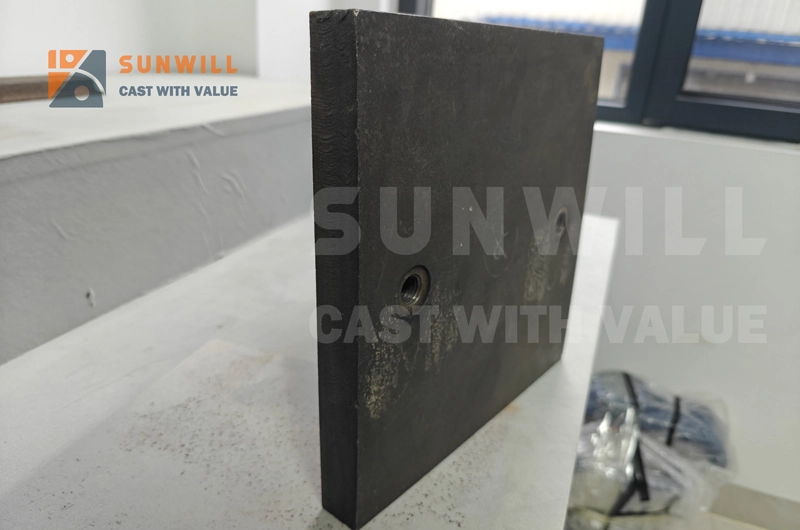
Best-in-class sites treat the transfer point like the crusher: measure the wear, match the material, and buy on tons produced and stoppages avoided. Small stress-relief cracks are not a defect; they are the plate doing its job. And when the duty is extreme, a custom-fabricated liner system beats a stack of raw plate every time.
For the grinding and milling side of the same plants, our grinding roller and mill liners for cement and mining guide covers engineered cast liner profiles.
Ready to stop patching chutes? Sunwill’s engineering team — metallurgists and foundry engineers with 20+ years in wear-resistant materials — can run a personalized liner analysis against your material abrasiveness, throughput, impact, and temperature profile. We are an ISO 9001:2015 certified foundry with 15,000㎡ of production space, 8,000 t of annual capacity, and wear parts shipped to 40+ countries, covering our MMC, Bimetallic, and DHT composite technologies.
Contact our technical team for a personalized chute and hopper liner analysis and a free thickness-selection sheet built for your specific transfer points. To see how our composite technologies are built, review our composite (MMC/DHT) technologies, or browse our full range of mining wear solutions.