
Wear Parts RFQ Specification Guide (Buyer’s Checklist)
Wear Parts RFQ Specification Guide (How to Brief a Foundry)
A good wear parts RFQ specification guide starts with a simple truth: the quality of the quote you receive is capped by the quality of the specification you send. A limestone quarry in the Midwest learned this when they emailed a foundry a photo of a worn jaw plate with the message “send quote.” They got three quotes that varied by 40% — and the lowest one arrived with the wrong tooth profile, because nothing in the RFQ said what profile was needed. The “bargain” was unusable, the reorder slipped by three weeks, and the crusher ran on a patched plate in the meantime. The fix was not a better foundry; it was a better brief.
This guide shows you exactly what to put in an RFQ so every foundry quotes the same part, in the same material, to the same standard. A complete RFQ produces comparable quotes, right-first-time fit, and traceable quality. A thin RFQ produces surprises — and surprises in wear parts are always expensive. By the end you will have a copy-paste template you can send to any foundry tomorrow.
What an RFQ Package Should Contain
Think of the RFQ as the contract before the contract. It should let a competent foundry price the part without guessing, and it should let you reject a wrong quote before it is cast. A complete package has four layers:
Identity — your company, the machine make/model, the part name and position (fixed jaw, mantle, blow bar, etc.).
Geometry — a drawing or 3D model, critical dimensions, and tolerances.
Material & quality — grade, standard, hardness target, inspection scope, certificate requirements.
Commercial — quantity, annual demand, lead time, Incoterms, tooling ownership.
If any layer is missing, the foundry fills the gap with an assumption — and assumptions are where cost and fit diverge. The rest of this guide builds each layer so you can send a brief no supplier has to guess at.
The 7 Spec Fields Every Wear Parts RFQ Needs
These seven fields are the minimum for a comparable, fit-for-purpose quote. Miss one and you are comparing different parts at different prices. This table is the quick-reference checklist that answers “what should an RFQ for castings include” — the block worth pinning above your template.
# Spec field What to specify Why it matters
1 Drawing / 3D model Format (STEP/PDF), critical dims, profiles Defines the physical part; prevents wrong profile
2 Material grade & standard ASTM/EN grade, e.g. A532 Class I Type 4 Fixes chemistry; “alloy steel” is not a grade
3 Hardness & microstructure Target HRC/HB and any microstructure limit Verifies the part will perform and is inspectable
4 Dimensions & tolerances Key fits, bore, seating surfaces, ± values Guarantees fit without on-site grinding
5 Quantity & annual demand Per order + forecast volume Drives price, MOQ and buffer planning
6 Application duty Ore type, abrasiveness, impact, moisture Lets the foundry confirm or improve the grade
7 Inspection & documentation UT/MPI, MTC, dimensional report scope Makes quality verifiable, not promised
1. Drawing / 3D model (format, critical dims)
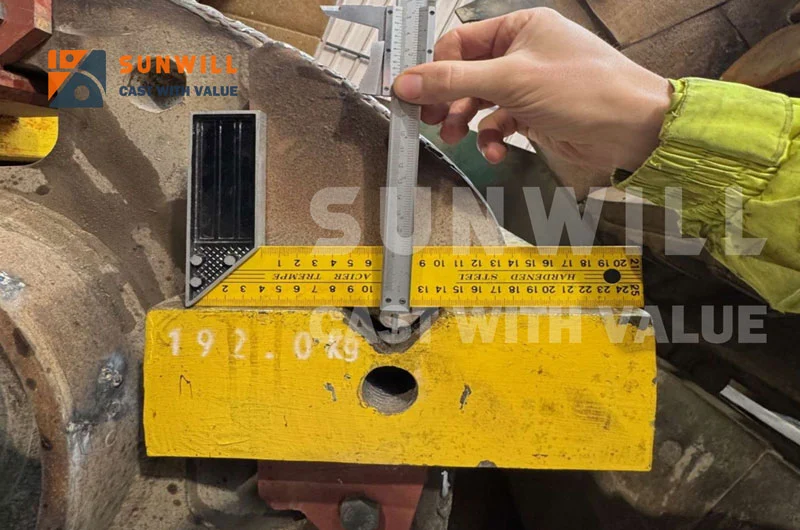
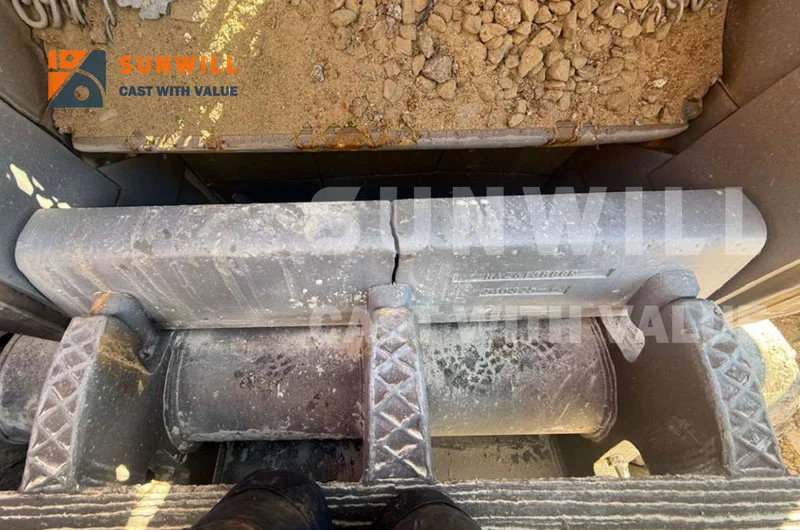
Send the drawing, not a photo. A photograph shows wear and perspective distortion; a CAD file or dimensioned PDF shows the part as it should be made. Specify the format you can supply — STEP, IGES or a dimensioned PDF — and call out the critical dimensions: overall length, profile tooth height and pitch, bore and keyway, and any seating surface. For a liner, the chamber-matching profile is the single most important geometry; state it explicitly or reference the OEM profile code.
If you only have a worn sample, say so, and provide the closest dimensioned reference plus a note that the part is at end-of-life. A good foundry can reverse-engineer from a sample, but they need to know it is worn so they restore — not copy — the original profile.
2. Material grade & standard (ASTM/EN)
Name the actual grade and the standard it meets. “Alloy steel” or “high chrome” is not a specification; ASTM A532 Class I Type 4, or EN-GJN-HB555(XCr18), is. Standards remove ambiguity: ASTM A532 covers the Ni-Hard and high-chrome white-iron families with defined chemistry and hardness, and EN 12513 is its European equivalent. For alloy steels, cite the relevant ASTM or EN grade with the required chromium, molybdenum and carbon bands.
A gold mine in West Africa specified only “Ni-Hard” on a slurry-pump liner RFQ. Two suppliers quoted different types; the mine accepted the lower price, which turned out to be Type 1 — a high-carbide grade built for sliding abrasion, not the fine, corrosive slurry where Type 4 (higher chromium, M7C3 carbides) was needed. The liners eroded in six weeks instead of the expected season. The missing ASTM type cost more than the grade premium would ever have.
3. Hardness & microstructure target
Hardness is the bridge between chemistry and performance, so state the target and the measurement method — Brinell (HBW) or Rockwell (HRC) — and the location and number of test points. For white irons, also state any microstructure limit (e.g., carbides, retained austenite) if your application is sensitive to it. This field is what makes the part inspectable on arrival: without a hardness target, “soft” is an opinion; with one, it is a pass/fail.
Pair the hardness target with the grade. A foundry cannot hit “60 HRC” on a material that maxes at 55, so the two fields must agree. If they conflict, the foundry should flag it — which is exactly the kind of engineering feedback a complete RFQ invites.
4. Dimensions & tolerances
Tolerances decide whether the part fits on arrival or needs a grinder and a prayer. Specify the critical fits: bore diameter, seating shoulder, keyway, and any surface that contacts the crusher frame. State the tolerance band (e.g., ±0.5 mm on seating faces). Tight tolerances cost more to hold, so apply them where fit matters and relax them where they do not — a foundry can advise, but only if you mark which dims are critical.
A 2 mm oversize on a liner can force a damaging fit or a costly on-site machine. The tolerance field is cheap insurance against both.
5. Quantity & annual demand
State both the immediate order quantity and your realistic annual demand. Quantity drives price and minimum order quantity; annual demand lets the foundry plan pattern retention, buffer stock and even alloy-buying, which flows back to you as a better price and lead time. Even a rough forecast (“approximately 40 sets per year across three crushers”) is far better than silence, because it tells the supplier whether you are a one-off or a program.
6. Application duty (material, impact, abrasion)
Describe what the part actually touches. Ore or rock type, abrasiveness and silica content, feed size, moisture, impact level, and tramp risk. This field lets a competent foundry confirm your grade or propose a better one — and it is where real value enters the conversation. A part specified only by drawing, with no duty data, may be perfectly made and perfectly wrong for your rock.
For perspective on material fit: high-manganese (Hadfield) steel work-hardens under heavy impact and stays common for high-shock jaw and cone liners, while martensitic alloy steels and high-chrome white irons dominate abrasive, lower-impact duties. SUNWILL’s foundry does not cast Hadfield manganese; our portfolio centers on alloy steel, high-chrome white iron, ceramic-composite and bimetallic solutions, and our engineers use your duty data to recommend within that range — or to tell you honestly when your duty needs something else.
7. Inspection & documentation scope
State what proof you require: spectrometer chemistry report, hardness test points, dimensional inspection report, UT or MPI for thick/critical sections, and a Material Test Certificate (MTC) tied to a heat number. Inspection scope is what converts “we guarantee quality” into “here is the evidence.” Specify who pays for third-party inspection if you require it, and what acceptance criteria trigger a reject.
Use our RFQ template below to brief foundries on one consistent spec sheet — comparable quotes start with a comparable brief.
Getting Material Grade Selection Right
Grade selection is where most RFQs fail silently: the buyer names a grade they used last time without checking it fits the duty. A short checklist keeps the choice honest.
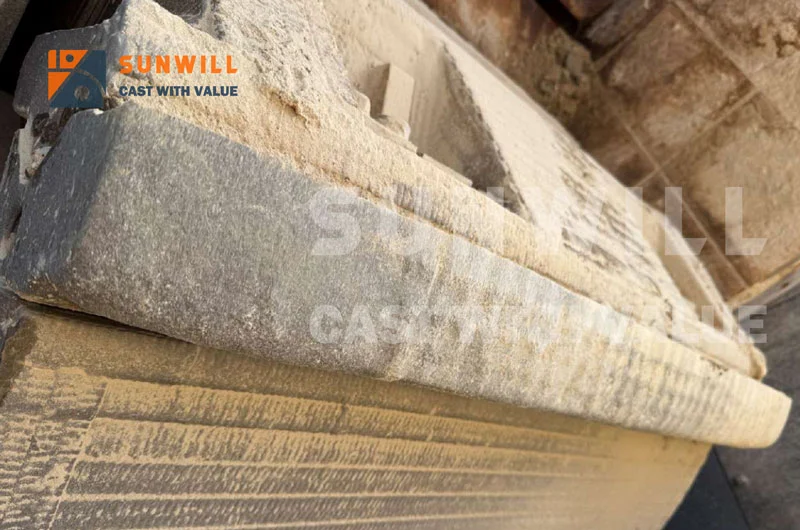
Start from the wear mode. Sliding abrasion and fine feed reward hardness (high-chrome white iron, ceramic composite). Heavy impact and tramp reward toughness (work-hardening manganese, tough alloy steel). Mixed duties reward a composite or bimetallic build.
Name the standard, not the nickname. “Ni-Hard” is a family; “ASTM A532 Class I Type 4” is a part. The type decides chromium, carbide form and hardness.
Match hardness to the grade’s envelope. Do not specify a hardness the alloy cannot reach or hold without cracking.
Let the foundry challenge it. If your specified grade looks wrong for the duty you described in field 6, a good supplier will say so. Treat that as a signal of competence, not insubordination.
Document the rationale. Note why this grade was chosen so the next buyer does not revert to “what we ordered before.”
Commercial Terms to Specify (Incoterms, lead time, tooling)
The part is only half the RFQ. The commercial frame decides total cost and risk.
Incoterms. State whether the quote is EXW, FOB, CIF or DDP. This fixes who owns freight, insurance and import duty — and prevents the surprise-invoice problem. A quarry in Southern Europe once omitted Incoterms; two suppliers quoted “delivered” with opposite meanings, and the lower number hid €3,000 of customs the buyer then owed.
Lead time. Require a realistic lead time for first article and for repeats, and state your required delivery date so the foundry can confirm feasibility, not guess.
Tooling & pattern ownership. Clarify who pays for and owns the pattern or tooling. If the supplier owns it, confirm they will retain it and not charge again at reorder. If you own it, state that you expect it returned or held against your account.
Payment terms. Net terms, deposit percentage, and any milestone structure for first articles.
Validity. Quote validity period, because alloy and freight prices move.
Common RFQ Mistakes That Inflate Cost
These are the errors that turn a cheap RFQ into an expensive part.
Photo instead of drawing. Forces assumptions; guarantees a wrong profile at least once.
Grade by habit. Specifying last year’s alloy without checking the duty — often the wrong material for changed feed.
No tolerances. Ships a part that needs on-site machining or does not seat, adding labor and downtime.
Vague “high chrome” or “alloy steel.” Two foundries quote two different materials at two different prices; you compare noise.
Duty data omitted. Removes the foundry’s ability to improve the spec or warn you.
Incoterms missing. Hidden freight and duty surface as a surprise bill or a stuck shipment.
No inspection scope. You receive a part you cannot verify and a “guarantee” you cannot enforce.
Single-part RFQ, no volume. You forfeit the price and lead-time leverage that annual demand provides.
Copy-Paste RFQ Template
Drop your details into this block and send it to every foundry. Consistent input produces comparable output — the foundation of a fair supplier comparison.
WEAR PARTS RFQ — [Your Company]
Date: [DD/MM/YYYY] | Valid until: [DD/MM/YYYY] | Quote to: [name/email]
1. PART IDENTITY
– Machine: [Make / Model, e.g., Metso C140 jaw]
– Part: [Fixed jaw plate / Mantle / Blow bar — position]
– Current OEM part no. (if known): [________]
2. GEOMETRY
– Drawing / model attached: [YES/NO — format: STEP / PDF]
– Critical dims (length / profile height / bore / seating): [values]
– Note if sample is worn end-of-life: [YES/NO]
3. MATERIAL GRADE & STANDARD
– Grade: [e.g., ASTM A532 Class I Type 4 / EN-GJN-HB555(XCr18)]
– If open to recommendation, state: [preferred family or “supplier to propose”]
4. HARDNESS & MICROSTRUCTURE
– Target: [e.g., 60 to 65 HRC, min 600 HBW]
– Test method & location: [Brinell at 3 points / Rockwell C]
– Microstructure limits (if any): [________]
5. DIMENSIONS & TOLERANCES
– Critical fits & tolerances: [bore ±0.5 mm, seating ±0.3 mm]
– Non-critical dims: [as per drawing]
6. QUANTITY & DEMAND
– This order: [qty] sets
– Estimated annual demand: [qty] sets across [n] machines
7. APPLICATION DUTY
– Material processed: [ore/rock type, silica %]
– Feed size / moisture: [________]
– Impact level / tramp risk: [low–high]
– Current wear life (if known): [tons or weeks per set]
8. INSPECTION & DOCUMENTATION
– Spectrometer chemistry report: [REQUIRED]
– Hardness test report: [REQUIRED]
– Dimensional inspection report: [REQUIRED]
– UT / MPI (thick/critical sections): [YES/NO]
– MTC tied to heat number: [REQUIRED]
– Third-party inspection (if required): [________]
9. COMMERCIAL TERMS
– Incoterms: [EXW / FOB / CIF / DDP]
– Required delivery date: [DD/MM/YYYY]
– Lead time (first / repeat): [________]
– Tooling/pattern ownership: [buyer/supplier retains]
– Payment terms: [________]
10. CONTACT
– Name / role: [________]
– Email / phone: [________]
Request a material recommendation for your duty — send us this completed template and our engineers will confirm the grade or propose a better-fit alloy before quoting.
How SUNWILL Responds to an RFQ
When you send SUNWILL an RFQ, you reach an ISO 9001:2015-certified Chinese foundry producing alloy-steel, high-chrome white iron, ceramic-composite and bimetallic wear parts. We treat an RFQ as the start of a documented engineering process, not a price race.
What happens when you send us a brief:
We read the duty before the drawing. Our application engineers review your ore, crusher model and wear pattern and confirm the grade — or propose a better one — before quoting.
We quote to your spec, completely. Every quote states the grade, standard, hardness target, inspection scope and Incoterms, so what you compare is what you get.
We confirm feasibility, not just price. If a tolerance, lead time or grade looks wrong for your duty, we say so and explain — because a wrong part shipped on time is still a failure.
We document quality. Spectrometer analysis, hardness testing and a heat-number-linked MTC come with the shipment, so the part you receive is verifiable on arrival.
We retain your patterns. Reorders pull the same pattern and alloy recipe, so a part two years later matches the first.
Our promise is CAST WITH VALUE: a response that respects your specification and improves it where the duty allows.
Send us your completed RFQ and we will return a like-for-like quote with a material recommendation you can drop straight into your supplier comparison.