
Chocky Bars and Wear Bars for Excavators, Loaders and Hoppers
Chocky Bars and Wear Bars for Excavators, Loaders and Hoppers
The cheapest ton you will ever save is the one that never grinds a hole in your bucket. Every shift, an excavator lip drags through abrasive rock, a loader bucket scoops the stockpile, and a hopper wall takes the full drop of the next truckload. Unprotected, those surfaces shed steel week after week until someone welds a plate over the damage and hopes. Buyers who search for chocky bars wear bars are looking for the alternative: hard, formable, weld-on protection that takes the abuse instead of the parent steel. SUNWILL is an ISO 9001:2015 certified Chinese foundry producing wear-resistant castings for cement, aggregate, mining and recycling operations, and our promise on every handling-wear package is the same: CAST WITH VALUE.
This guide covers what chocky bars actually are, how they differ from wear bars and wear liners, where to place them based on your real wear pattern, how to weld them without ruining them, and how they compare with bimetallic wear plates and hardfacing.
Key takeaway: Chocky bars work because they separate two jobs that no single material does well. A hard chromium white iron face resists abrasion, while a weldable mild steel backing carries the attachment. That duplex construction is what lets you fix cast-hardness wear resistance onto a curved bucket lip that no plate could follow.
What Are Chocky Bars?
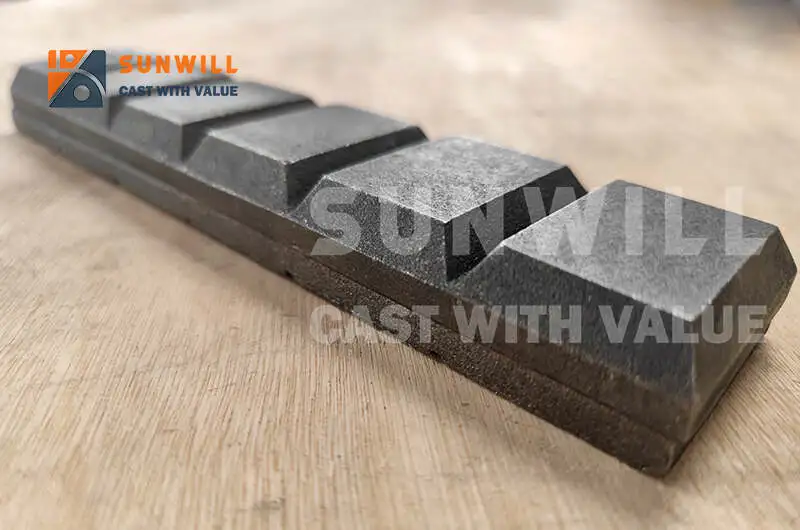
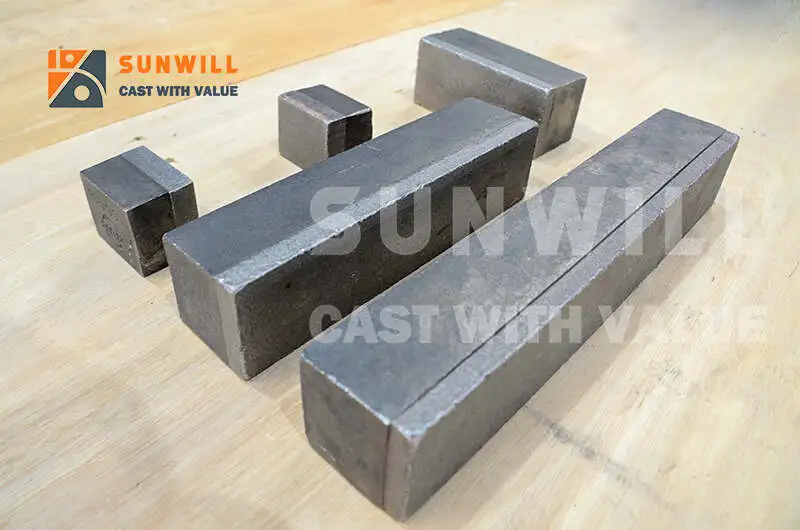
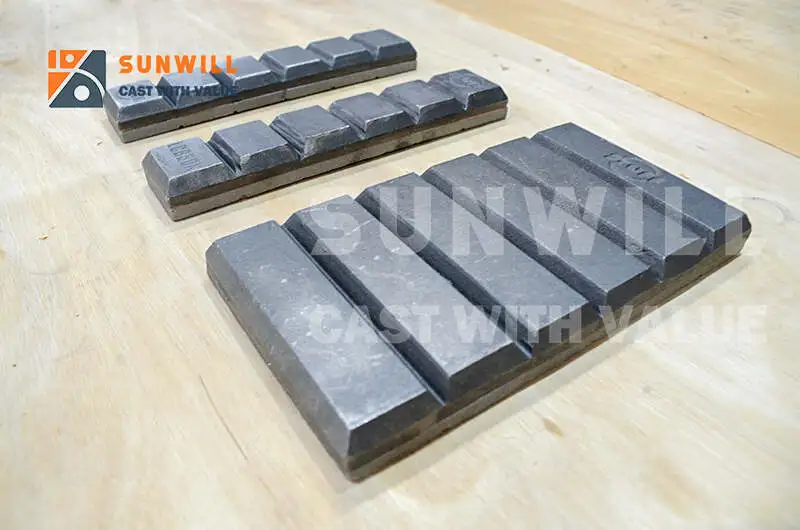
A chocky bar is a duplex wear element: a hard cast white iron wear face metallurgically bonded to, or cast onto, a weldable mild steel backing strip. Some designs are cast as segmented blocks along a continuous steel backing; others are individual blocks. The name comes from the segmented, chocolate-bar appearance of the notched versions.
The engineering problem it solves is fundamental. Chromium white iron is extremely hard and abrasion resistant, but it cannot be welded, it cannot be bent, and it is brittle. Mild steel welds beautifully and bends easily but wears away fast. Bolting the two functions together in one part gives you a wear face you could not otherwise attach and a fixing method that does not compromise the wear face.
The Notched, Formable Design
The critical feature is the notch or segment pattern across the bar. Because the hard wear face is divided into discrete blocks with the flexible steel backing running beneath, the bar can be bent to follow a curved surface. The hard segments do not bend; the backing does, and the gaps between segments open or close to accommodate the curve.
This is what makes chocky bars uniquely suited to buckets. A bucket lip and its side wings are compound curved surfaces, and a flat wear plate simply cannot follow them without extensive cutting and fitting. A notched chocky bar can be cold-formed to the contour on site.
The same notching allows cutting to length at the segment gaps, so a standard bar can be adapted to fit an irregular area without special ordering.
Typical Hardness and Construction
Chocky bar wear faces are generally cast in chromium white iron, with published hardness figures in the region of 700 HB or approximately 63 HRC depending on the grade and supplier.
Two clarifications on our own scope, because buyers deserve precision on this. Chocky bar wear faces are chromium white irons, which we cast. Ni-Hard nickel-chromium white iron to ASTM A532 is not a SUNWILL cast stock line; where a complete wear solution genuinely requires it, we specify the correct grade and source it as part of the package, and the properties are described in Ni-Hard white iron wear parts. Separately, tungsten carbide composite and hardsurfacing consumables appear in this article as market comparison only. SUNWILL does not manufacture WC composites.
Chocky Bars, Wear Bars and Wear Liners: One Family, Three Formats
The chocky bars wear bars category covers several related formats, and choosing the wrong format is more common than choosing the wrong material.
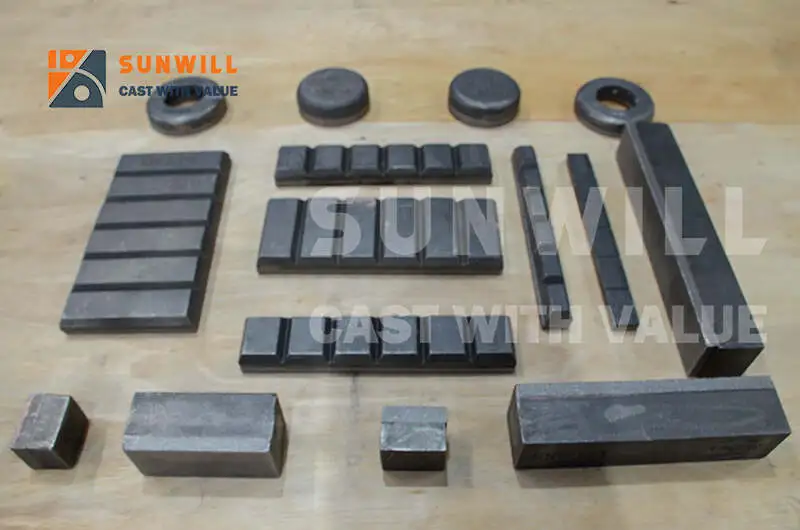
Chocky bars and chocky blocks are the notched, formable option. Best where the surface is curved, where the wear pattern is uneven, and where you want to place protection selectively rather than cover an entire area. They are also the most impact-tolerant of the three because the segmentation limits crack propagation across the wear face.
Wear bars are longer, often continuous or lightly segmented bars intended for straighter runs: bucket lips, loader edges, chute rails and hopper edges. They provide a more continuous wear surface with fewer gaps, which suits sliding-abrasion duty where material flows along the surface rather than impacting it.
Wear liners and wear plates cover area rather than lines. Flat or gently curved surfaces such as hopper walls, chute floors and truck body panels are better served by plate products. This is where our bimetallic wear plates for chutes and hoppers belong, and the comparison against cast alternatives is worked through in overlay plate versus castings.
The right combination on a single machine usually involves all three. A loader bucket might carry heavy chocky bars on the corners and wings where gouging concentrates, wear bars along the straight sections of the lip, and a plate liner in the bucket floor where material slides.
Wear Zone Placement: Where to Put Them and Where Not To
Placement is the part most operations get wrong, and it wastes more money than material selection ever does. A chocky bars wear bars layout should be drawn from evidence, not from a catalogue diagram.
Map the Wear First
The instinct is to cover everything. Resist it. Full coverage is expensive, adds significant weight to a bucket, and is usually unnecessary because wear is never uniform.
The correct method is to observe the existing wear pattern on the unprotected part. Every bucket, hopper and chute develops a characteristic wear map determined by material flow, digging technique, and geometry. Photograph it, measure remaining thickness at several points, and mark the zones where metal loss is actually occurring.
Then place protection on those zones. You will typically find that a modest fraction of the surface area accounts for most of the metal loss.
Excavator Buckets
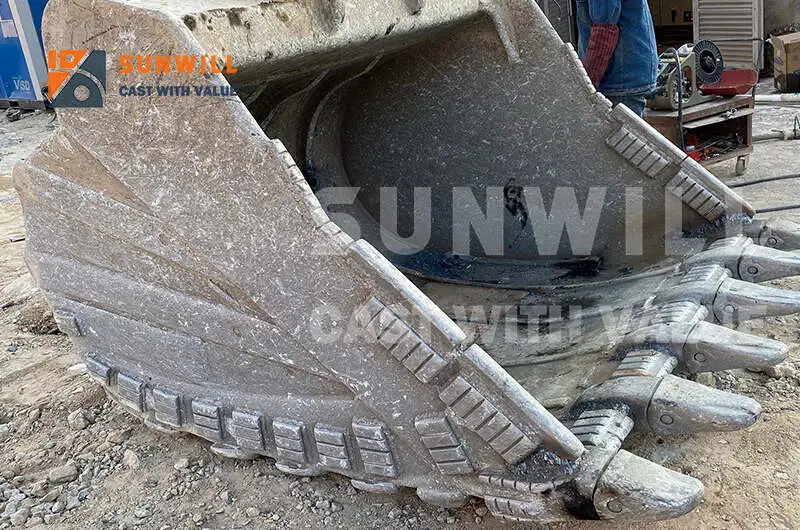
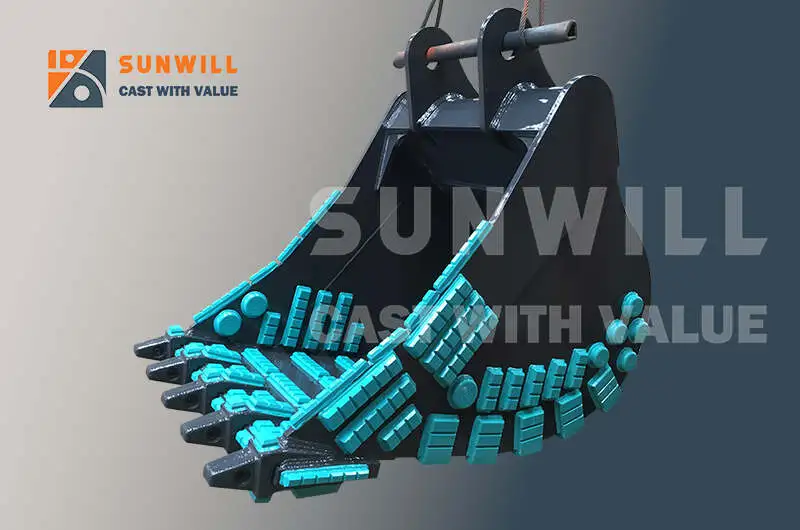
Corners and side wings take the heaviest gouging in most digging duties. These are prime chocky bar locations because the surfaces are curved and the load is high-impact.
The area behind the teeth and adapters sees concentrated abrasion as material funnels past. Bars here protect the lip structure that carries the tooth system. Tooth and adapter selection itself is a separate subject, covered in bucket teeth wear parts.
The bucket floor and heel wear from sliding as the bucket drags and dumps. Longitudinal runs of wear bars aligned with the material flow direction work better here than transverse placement.
The back of the bucket is often over-protected. Check whether it is actually wearing before you spend on it.
Loader Buckets
Loader duty differs from excavator duty because the machine drives into a pile rather than dragging through a face.
The cutting edge and lip take the primary abrasion. The bucket floor behind the lip wears from continuous material sliding. The side cutters and corners take impact from pile penetration. The spill guard and top edge usually need less than people assume.
Hoppers, Rock Boxes and Chutes
Here the wear mechanism changes from digging to impact plus sliding flow, and placement follows the material trajectory.
The primary impact zone in a hopper, where truck-dumped material lands, takes the highest-energy blow. Rock boxes and heavy liners suit this location better than thin protection.
The flow path down the walls takes sliding abrasion, which is where continuous wear bars or plate liners perform well.
Corners, transitions and the discharge lip concentrate flow and wear faster than the flat areas. These are high-value protection points.
Chute sides and the outer radius of any turn take the load as material is deflected. The inside radius often barely wears at all.
Leave Deliberate Gaps
A counterintuitive but important point: the gaps between chocky bar segments are useful. Fine material packs into them and forms a semi-permanent bed that itself resists wear, a phenomenon sometimes described as autogenous protection. Spacing bars deliberately, rather than butting them tight, can protect the surface between them at no material cost.
Spacing also reduces weight and cost, and on a bucket, weight matters directly. Every kilogram of protection is a kilogram off your payload.
A quarry running front-end loaders had been paying a contractor to hardface their bucket lips every few weeks, and treating it as routine. When their maintenance planner finally photographed and measured the wear pattern, it turned out nearly all the loss was concentrated at the two corners and a short section behind the centre teeth. They fitted heavy chocky bars on just those zones and left the rest bare. The repair interval stretched out substantially, and they were buying a fraction of the protection they had assumed they needed. Mapping the wear was worth more than any grade upgrade.
Not sure where your wear is concentrated? Send us photographs of your worn buckets and hoppers and we will map the zones with you. Contact the SUNWILL wear team for a placement review.
Cutting, Forming and Welding: Getting the Attachment Right
More chocky bars wear bars installations fail at the weld than at the wear face. The rules are simple and they are not optional.
Never Weld the White Iron
The hard cast wear face must never be welded, arc-struck or heated directly. It is a brittle high-carbon iron; welding it will crack it, and a cracked wear face fails prematurely and unpredictably.
All welding is done on the mild steel backing only, and on the parent plate of the bucket or hopper. The backing exists precisely to give you a weldable surface.
Cutting to Length
Cut at the segment gaps, through the steel backing only, using a cutting method appropriate to the backing material. Avoid cutting through the hard segments. If your required length falls mid-segment, plan the layout to shift the cut to the nearest gap rather than forcing it.
Forming to Contour
Cold form the bar to the surface contour by bending the backing at the notches. Work progressively rather than forcing the whole bend at once, and support the bar so the load goes into the backing and not into the hard segments. Do not heat the bar to make it bend more easily; heating risks damaging both the wear face and the bond.
Welding Practice
Clean and prepare the parent surface. Remove old weld, scale, packed fines and paint from the area. A bar welded onto packed material or old cracked overlay will not stay attached.
Consider preheat. Welding onto thick, cold, high-strength parent plate, and onto backing strips, benefits from preheat to reduce cracking risk in the heat-affected zone. The appropriate preheat depends on the parent plate grade and thickness.
Use an appropriate low-hydrogen electrode or wire matched to the backing and parent materials, following a qualified procedure. This is a welding engineering decision, not a field improvisation.
Stitch weld along the backing edges rather than laying one continuous heavy bead. Stitch welding controls heat input, limits distortion of the bucket or hopper plate, and provides adequate attachment strength. Weld sequence matters: alternate along the bar rather than working end to end, to spread the heat.
Keep the weld low and out of the wear path. A tall weld bead standing proud of the surface becomes a wear target itself and will be eroded away, taking the attachment with it. Fillet welds along the backing edge should sit below the wear face profile.
Watch distortion. Excessive heat input into a bucket floor or hopper panel can distort it. Balanced sequencing and controlled stitch length prevent this.
Safety Notes
Grinding, cutting or arc-striking on chromium white iron generates hard particulate. Follow appropriate respiratory and eye protection practice, and be aware that pieces broken from a hard wear face can be sharp and can fly. Working inside hoppers and chutes brings confined-space and fall considerations that outrank any wear-parts consideration.
A maintenance supervisor at a cement plant inherited a set of hoppers where a previous crew had welded chocky bars with a single heavy continuous bead standing proud of the wear face. Within two months, the beads had eroded and half the bars had detached, several of them into the feeder below. Refitting them with stitch welds recessed below the segment height, on properly cleaned plate, produced the service life the material had always been capable of. Nothing was wrong with the bars. Everything was wrong with the weld.
Chocky Bars, Bimetallic Plate and Hardfacing Compared
Each option occupies a genuine niche, and a sound chocky bars wear bars decision means being honest about the geometry and the duty rather than about hardness figures.
Chocky bars win on curved surfaces, on selective placement, and where impact accompanies abrasion. Their segmentation tolerates impact and limits crack spread. They are quick to fit on site with normal welding equipment, and they can be replaced individually as they wear. Their limitations are the gaps in coverage and the labour involved in fitting many individual elements over a large area.
Bimetallic wear plates win on flat and gently curved area coverage. They provide continuous protection with no gaps, typically at lower cost per square metre of protected area than assembling bars, and they suit chute floors, hopper walls and liner applications. Their limitation is conformability: a plate cannot follow a compound curve, and cutting and fitting plate to an irregular shape is slow. Our detailed treatment is in bimetallic wear plates for chutes and hoppers, and the practical questions are answered in wear plate liner FAQ.
Weld overlay and hardfacing win where geometry is genuinely awkward, where the surface must be rebuilt as well as protected, and where a skilled welder and consumables are already on site. The overlay conforms to anything. Its limitations are consistency between applications, dependence on welder skill, cumulative heat input into the parent structure over repeated repairs, and the recurring labour cost. Many operations discover that the third or fourth hardfacing cycle on the same bucket costs more in total than fitting bars would have. The comparison is developed further in overlay plate versus castings.
The realistic answer for most plants is a combination. Bars on the curved, high-impact, selectively worn zones. Plate on the flat, high-flow area coverage. Overlay for repair of the awkward remainder.
Key takeaway: Choose format by geometry before you choose material by hardness. Curved and selectively worn surfaces call for chocky bars, flat high-flow areas call for bimetallic plate, and awkward rebuild work calls for overlay. Most buckets and hoppers need a combination rather than a single answer.
Selecting by Duty: Clinker, Aggregate and Scrap
Different industries load these parts differently, and a chocky bars wear bars specification should follow the duty rather than the equipment type.
Cement plant duty is abrasive but comparatively low in unpredictable impact. Clinker is hard and hot, limestone is abrasive, and the handling equipment sees consistent, repetitive loading rather than random heavy shocks. Harder wear faces perform well here because impact risk is lower. Clinker handling adds a thermal dimension, and elevated temperature at the wear surface affects material choice. The plant-wide context is in cement plant wear parts and the programme view in SUNWILL wear parts and solutions for cement plants.
Aggregate and quarry duty brings high abrasion with moderate to high impact, especially in primary hoppers taking direct truck dumps and in loader buckets penetrating blasted rock piles. Here the impact tolerance of segmented bars is a real advantage over a large monolithic hard plate. Grade selection across the aggregate line is covered in aggregate wear parts selection, with the downtime-defence view in aggregate production wear solutions.
Scrap and recycling duty is the most punishing for impact. Scrap handling involves grapples, heavy irregular objects, and loads that shift and catch. This is the duty where a very hard, brittle protection choice is most likely to crack, and where segmented bars with a tough backing and generous spacing perform best. The shredder-side parts picture is in metal scrap shredder wear parts.
Sand and fines handling at the other extreme is nearly pure sliding abrasion with little impact. Here continuous coverage matters more than impact tolerance, which tends to favour plate over bars.
Total Cost of Ownership
The parts price is a poor guide, so build the comparison properly.
Protected life per fitting. How long does the protection last before it needs renewal? Divide the fitted cost, including labour, by that interval.
Fitting labour. This is often the dominant term and it is regularly ignored. A hardfacing cycle consumes skilled welder hours repeatedly. Fitting bars is a one-time labour event that lasts several times longer. Bars fitted with correct stitch welds can also be replaced individually as they wear, without redoing the whole area.
Equipment availability. A bucket in the workshop is a machine not loading trucks. Extending the interval between protection renewals directly increases machine availability, and on a busy pit that value usually exceeds the parts cost.
Parent structure preservation. The strategic term. The purpose of all of this is to stop the bucket, hopper or chute structure itself from wearing out. A bucket shell that is protected in time can run for many years; one that is allowed to wear through requires structural repair or replacement at a cost that dwarfs any protection programme.
Payload and fuel. Protection adds weight. Selective placement based on a real wear map, rather than blanket coverage, keeps that weight penalty small.
The SUNWILL CAST WITH VALUE Handling-Wear Program
Our approach to supplying chocky bars wear bars and handling-wear protection runs in four steps.
First, we map the wear. Photographs and thickness measurements of your existing worn parts, plus material, tonnage and duty details. We would rather see your worn bucket than your parts list, because the wear pattern tells us what the parts list cannot.
Second, we select format by zone. Chocky bars where geometry is curved and impact is present, wear bars on straight high-flow runs, and bimetallic or cast liners for area coverage. Selective placement, with deliberate spacing, rather than blanket coverage.
Third, we specify the grade by duty. Chromium white iron wear faces matched to the abrasion and impact balance of each zone, cast under ISO 9001:2015 with material documentation. Where a complete solution calls for grades we do not cast, including Ni-Hard, we specify and source them rather than substituting something we happen to hold.
Fourth, we support the installation. Cutting and forming guidance, welding practice notes for your welding engineer to qualify against, and a re-inspection interval so the next renewal is planned rather than discovered.
The same principles extend across the plant. Our ceramic roller liners for vertical mill work covers grinding wear, and VSI rotor shoes and anvils covers rotor shoes and anvils downstream of the same hoppers these bars protect.
CAST WITH VALUE means the protection is engineered against your fitted cost and your equipment availability, not against the lowest unit price on a quotation.
Frequently Asked Questions
What are chocky bars wear bars and how do they work?
They are weld-on wear protection elements built from two materials with different jobs. A hard chromium white iron wear face resists abrasion, and a weldable mild steel backing carries the attachment to the equipment. Chocky bars are notched into segments so the backing can be bent to follow a curved surface such as a bucket lip, and cut to length at the gaps. Wear bars are longer, less segmented versions for straighter runs. Both are welded through the backing only, never through the hard face.
Can chocky bars be welded directly on the hard wear face?
No, and this is the most important installation rule. The cast white iron face is brittle and high in carbon; welding or arc-striking on it will crack it and cause premature failure. All welding is performed on the mild steel backing and the parent plate, using a qualified procedure with appropriate electrode selection and preheat for the parent material. Keep weld beads low so they do not stand proud of the wear face and become a wear target themselves.
How do chocky bars wear bars compare to bimetallic wear plates?
They solve different geometric problems. Chocky bars conform to curves, allow selective placement on high-wear zones, and tolerate impact well because segmentation limits crack propagation. Bimetallic wear plates give continuous, gap-free coverage of flat and gently curved areas, usually at lower cost per protected square metre. Most operations use both: bars on bucket corners, lips and wings, and plate on hopper walls and chute floors.
How do I decide where to place chocky bars on a bucket?
Work from the observed wear pattern, not from a template. Photograph and measure the worn, unprotected part to find where metal is actually being lost. In most digging duties, that means corners, side wings and the area immediately behind the teeth, while the back of the bucket often wears far less than people assume. Protect the zones that are wearing, leave deliberate spacing between bars so fines can pack and provide additional protection, and keep total added weight in mind because it comes directly off your payload.
How long do chocky bars last?
Service life depends almost entirely on the abrasiveness of the material, the impact severity, the machine duty cycle and the quality of the installation, so any single figure would be misleading. The useful approach is to record the fitted date and the measured thickness at intervals on your own equipment, establish your own wear rate per zone, and set a renewal trigger from that data. Correct welding practice and selective placement typically influence achieved life more than small differences in wear-face hardness.
Conclusion
Handling wear is the least glamorous part of a wear programme and one of the most profitable to get right. The crusher gets the engineering attention, but the bucket, the hopper and the chute quietly consume welding labour, machine availability and eventually structural steel.
Specifying chocky bars wear bars properly comes down to four disciplines. Map the actual wear pattern before you buy anything. Choose the format by geometry, with bars for curves and selective zones and plate for flat area coverage. Weld through the backing only, with stitch welds kept below the wear face profile. And judge the result on fitted cost and equipment availability rather than on unit price.
Get those right and the parent structure outlives several generations of protection, which was the whole point.
Send us photographs of your worn buckets, hoppers and chutes along with your material and duty details. We will map the wear zones, propose a format and grade per zone, supply parts cast under ISO 9001:2015, and give your welding team the installation guidance to make them last.
Ready to stop rewelding the same bucket? Contact the SUNWILL wear engineering team for a wear-zone mapping review and a CAST WITH VALUE handling-wear plan.
Authoritative References